
Façade Consultant: Meaning, Role and When You Need One
Short answer
A façade consultant is an independent specialist appointed to advise on the design, performance, construction and condition of a building's external envelope. The role covers new-build design review, defect investigation, remediation strategy and expert evidence — and it is deliberately separate from the firms that supply or install the façade.
Last updated
On this page
Façade Consultant: Meaning, Role and When You Need One
Façade consultant meaning: a façade consultant is an independent technical adviser who specialises in the external envelope of buildings — walls, cladding, glazing, roofs at their junctions with walls, and everything that makes those elements perform together.
The term is used loosely in the construction market. Some façade consultants are chartered engineers; some are chartered surveyors or architects who have specialised; some practices combine all three. What they have in common is that they advise the client on the envelope, independently of the companies who will fabricate or install it.
What a façade consultant actually does
The work falls into four broad areas.
1. Design advice on new buildings
Working alongside the architect and structural engineer, the consultant develops and interrogates the performance of the envelope: weathering strategy, thermal performance and bridging, movement, wind loading, buildability, tolerance, maintenance and access. They write or review the performance specification, assess the specialist contractor''s design portion, and check that what is proposed can actually be built on this structure to these tolerances.
2. Investigation of existing buildings
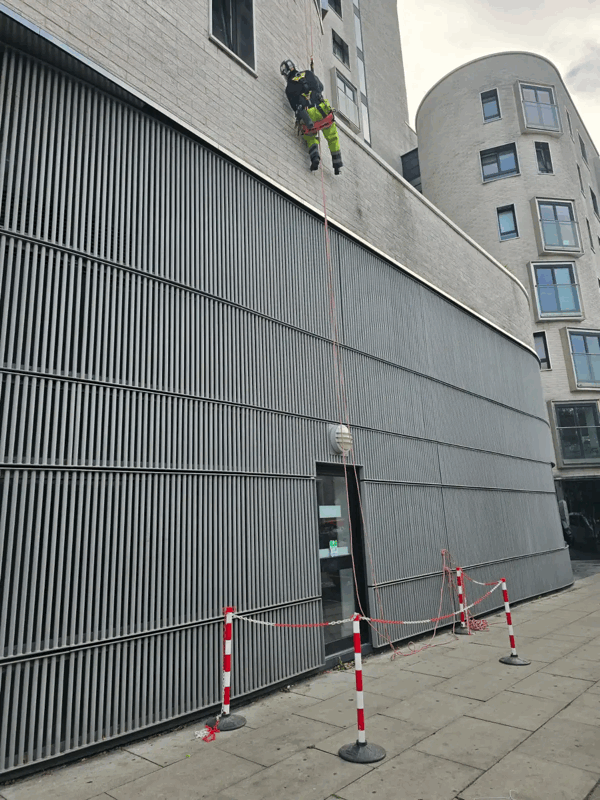
On existing buildings the questions are different: what is the wall made of, is it performing, and what has gone wrong. This is where most UK residential work sits. The consultant reviews records, inspects elevations, specifies and supervises opening-up at representative locations, records the actual build-up, and reports findings and unknowns. Related services include external wall survey, intrusive cladding survey and cladding investigation.
3. Remediation strategy and delivery support
Where work is required, the consultant develops options, sets out the scope, prepares specifications and tender documents, advises on procurement, reviews contractor proposals and monitors the work on site. On residential remediation this often includes supporting the client with funding applications and with communication to leaseholders.
4. Expert and dispute work
Façade consultants are frequently instructed to give technical opinion in disputes about defects, workmanship, specification compliance and cost — including formal expert witness appointments.
How the role differs from others
Architect. Leads the design and appearance of the building and coordinates the envelope with everything else. A façade consultant goes deeper into envelope performance and detail, and typically does not lead the wider design.
Structural engineer. Responsible for the primary structure and for the loads the façade imposes on it. The façade consultant deals with the secondary support system, panel fixings and their interaction with the structure.
Fire engineer. Sets the building''s fire strategy. The façade consultant addresses how the external wall construction relates to that strategy, and coordinates with the fire engineer on cavity treatment, barriers and material evidence. See cavity barriers in cladding.
Specialist façade contractor. Designs, fabricates and installs the system, usually under a contractor''s design portion. Their duty runs to their own package. The consultant reviews it for the client.
Building surveyor. Advises on buildings generally, including condition and defects. A façade consultant is narrower and deeper, and is usually brought in when the envelope is the problem.
The distinction that matters most to a client is independence. A consultant who does not supply panels or install systems has no commercial interest in which solution is chosen.
When a client should appoint one
Typical triggers:
- A new building where the envelope is complex, tall, exposed, or a significant share of the budget
- Persistent water ingress that repeated repairs have not resolved — see cladding water ingress
- Visible defects: panel movement, staining, corrosion, cracked or displaced trims, failed sealants
- A need to understand an existing external wall build-up where records are incomplete
- Preparing for or responding to an external wall assessment
- Pricing and scoping a remediation project, or reviewing a contractor''s proposal and price
- Applying for remediation funding, which normally requires a competent technical assessment
- A dispute over defects, workmanship or specification
Managing agents and resident-led boards often appoint a consultant specifically to hold the technical brief on the client side, because a residents'' board rarely has the expertise to interrogate a contractor''s proposal. Our page for managing agents covers this in more detail.
Typical scope of appointment
Appointments are usually staged, so the client can stop or change direction after each step.
Stage A — desktop review. Drawings, specifications, product data, warranties, previous reports, maintenance records. Output: what is known, what is missing, and what must be established on site.
Stage B — visual inspection. Elevations inspected from ground, roof, balconies or access equipment. Output: condition record, defect schedule, areas of concern.
Stage C — intrusive investigation. Representative openings, recording build-up, insulation, membrane, barriers, brackets and fixings. Sampling and testing where identification is uncertain. Verification of anchor capacity through cladding pull-out testing.
Stage D — reporting. Findings, with locations, photographs and the limits of the inspection stated clearly.
Stage E — options and strategy. Repair, partial remediation or full replacement, with indicative costs, programme and disruption.
Stage F — specification and procurement. Scope, drawings, performance requirements, tender documentation, tender review.
Stage G — construction monitoring. Inspections, benchmark approval, testing witness, non-conformance tracking, completion records.
Façade Consultant: Meaning, Role and When You Need One
What to look for when appointing
Because the title is not protected, check the substance rather than the label:
- Relevant professional qualifications and registration held by the individuals doing the work
- Demonstrable experience on the same building type, height and façade system
- Genuine independence from suppliers and installers
- Professional indemnity insurance appropriate to the value and risk of the project
- A written scope stating what is inspected, how many openings, what is tested, and what is excluded
- Clarity on who owns the report and who may rely on it
- Willingness to state the limits of their findings rather than overstate certainty
Ask for a sample report structure. The quality of reporting is the product you are buying.
How fees usually work
Fee structures vary by scope:
- Fixed fee for a defined survey or investigation package, which is the most common for existing residential blocks
- Day rate for advisory work, meetings and dispute support
- Percentage of construction value for full design and monitoring on larger remediation contracts
- Staged fees where each stage is authorised separately
Access costs — scaffolding, mast climbers, rope access, cherry pickers — are usually separate and can exceed the consultancy fee on tall buildings. Make sure the quotation states who arranges and pays for access, making good after opening-up, and laboratory testing. For overall project context, see how much recladding costs and how much it costs to replace cladding.
What a good report gives you
A useful façade consultant''s report tells you:
- What the wall is actually made of, at the locations opened up
- The condition of each layer and component
- Where the drainage and ventilation paths run, and where they are interrupted
- What was not inspected and what remains unknown
- Which findings are urgent, which are planned maintenance, and which are observations
- What the realistic options are, with indicative cost and programme for each
It does not give you a single-word verdict on a building. Conclusions about an external wall depend on the specific construction, the evidence available, and the competence of the person assessing it.
Related reading
- What is façade design in architecture? — how envelopes are designed in the first place
- Façade engineering companies — the types of firm in the market and how to choose one
- What is a ventilated façade? — the build-up most often investigated
- Cladding defects — what investigations typically find
- Cladding glossary — plain-English definitions
- Contractor directory — firms listed by region
If you want to discuss an existing building, you can book a survey or contact us.
Frequently asked questions
Is "façade consultant" a protected title? No. Anyone can use it, which is why the qualifications, experience and insurance of the individual doing the work matter more than the label on the letterhead.
Do I need a façade consultant as well as an architect? On a straightforward building, often not. On a tall, exposed or complex envelope, or on any existing building with an unexplained defect, the specialist depth is usually worth the fee.
How long does an investigation take? The site work on a single residential block is frequently a matter of days once access is in place; the programme is normally driven by access equipment and laboratory turnaround rather than inspection time.
Can a consultant tell me whether my building is safe? They can report what the wall is made of and what condition it is in, and a competent assessor can carry out the relevant assessment for the building. No article, and no inspection carried out remotely, can make that judgement about a specific building.
Who should hold the appointment? Usually the freeholder, the resident management company or the managing agent acting for them. Make sure the appointment names everyone who will need to rely on the report.
Can the same firm investigate and then do the remedial work? It happens, but it removes the independence that makes the investigation valuable. Most clients keep the two separate.
Façade Consultant: Meaning, Role and When You Need One