
Glossary · Two-word term
Rope Access
In short
method using ropes and associated equipment to access high or difficult areas
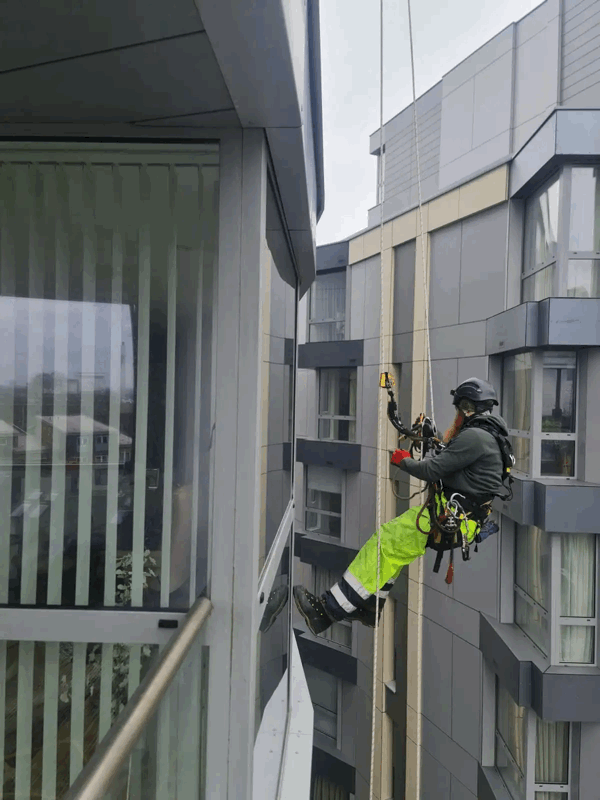
Rope access is a specialised work positioning method using a dual-rope system to facilitate high-level inspections and repairs on building facades. It provides a versatile, low-impact alternative to scaffolding for cladding surveys and remedial works on complex structures.
Last updated
On this page
Rope Access
Definition and Technical Principles
In the context of the UK built environment, rope access refers to a method of work positioning that utilises ropes and associated hardware to allow technicians to reach high or difficult areas of a building’s exterior. Originally adapted from speleological and mountaineering techniques, the modern industrial application is a highly regulated discipline focused on providing a stable working platform without the requirement for ground-based support or heavy mechanical structures.
The technical framework for rope access relies on the principle of redundancy. Systems typically employ two independently anchored ropes: a primary working line, which supports the operative and their equipment, and a secondary safety line, which serves as a back-up in the event of primary system failure. Technicians use specialised ascending and descending devices, harnesses, and cowstails to manoeuvre vertically and laterally across the building fabric. Within the cladding sector, this method is frequently utilised where traditional access solutions—such as scaffolding, mast climbers, or mobile elevating work platforms (MEWPs)—are deemed impractical due to site constraints, architectural geometry, or economic factors.
Applications in Cladding Evaluation and Remediation
Rope access is widely deployed across the lifecycle of external wall systems (EWS), particularly during the investigative and remedial phases. For buildings undergoing fire safety assessments, such as those required for an EWS1 form or a PAS 9980 appraisal, rope access allows for the close-range inspection of cladding panels, cavity barriers, and insulation layers. Technicians can perform intrusive surveys by removing small sections of the facade to document the internal buildup, often in multiple locations that would be cost-prohibitive to reach via scaffolding.
During repair and replacement programmes, the method is utilised for targeted interventions. This includes the replacement of individual damaged panels, the installation of retrofitted fire breaks, or the application of sealants and fixings. While large-scale wholesale cladding replacement often necessitates full scaffolding for material handling, rope access remains a primary tool for "snagging" lists, minor remedial works, and the maintenance of complex curtain walling systems where external protrusions make other access methods unworkable.
Relationship with Building Fabric and EWS
The interaction between rope access systems and the building fabric is a critical engineering consideration. Unlike scaffolding, which is a free-standing or tied structure, rope access imposes loads directly onto the building’s structural frame or dedicated anchor points. Before work commences, the suitability of the building to support these loads must be verified. This involves assessing the parapet strength, the presence of tested eyebolts, or the availability of structural steelwork suitable for temporary rigging.
In modern cladding systems, particularly those involving rainscreens or thin-gauge metal composites, the fragile nature of the external skin requires specific care. Rope access technicians use "edge protection" and "diversionary rigging" to ensure that ropes do not exert pressure on delicate cladding fins, gutters, or architectural features. Furthermore, for buildings with complex geometries—such as deep recesses, overhanging soffits, or curved facades—rope access provides a level of dexterity that allows for the inspection of the building fabric in areas that are frequently "blind spots" for ground-based cameras or drones.
Regulatory and Process Context in England and Wales
The use of rope access in England and Wales is governed by a robust hierarchy of health and safety legislation. The primary statutory instrument is the Work at Height Regulations 2005, which mandates that work at height must be properly planned, supervised, and carried out in a manner that is, so far as is reasonably practicable, safe. The regulations require a hierarchical approach to equipment selection, where collective protection (like scaffolding) is generally prioritised over personal protection (like rope access), unless the latter is justified by the nature of the task or the site risks.
Industry practice is largely defined by the British Standard BS 7985 (Code of practice for the use of rope access methods for industrial purposes) and the international guidelines provided by trade bodies such as IRATA (Industrial Rope Access Trade Association). These standards dictate the levels of technician certification—Level 1, 2, and 3—and require that every rope access team is supervised by a competent Level 3 professional. In the context of the Building Safety Act 2022, the documentation surrounding access methods, including Risk Assessments and Method Statements (RAMS) and anchor point testing records, forms an essential part of the "Golden Thread" of information for high-rise residential buildings.
Rope Access
Considerations for Building Owners and Managers
For Responsible Persons, such as Freeholders, Managing Agents, and RMC/RTM Directors, rope access offers several operational advantages and specific obligations. One primary benefit is the reduced "site footprint"; rope access equipment can be rigged and derigged daily, avoiding the security risks, privacy concerns, and aesthetic impact associated with long-term scaffolding. This is particularly relevant for occupied residential blocks where the "boxing in" effect of scaffold mesh can affect resident wellbeing.
However, building owners must ensure that the statutory requirements for the equipment are met. Any permanent anchor points (eyebolts) installed on a roof must be tested and certified every six months under BS EN 795. If a building lacks permanent anchors, "dead weight" trolleys or A-frames may be used, but these require careful structural assessment of the roof slab. Owners should also verify that the scope of insurance held by the contractor specifically covers industrial rope access, as standard public liability policies may exclude high-level work involving personal suspension.
Common Misunderstandings
A frequent misconception is that rope access is inherently more dangerous than using scaffolding. Statistically, when conducted under IRATA guidelines, rope access has one of the lowest incident rates in the construction and maintenance industry. The perceived risk often stems from the visual nature of the work rather than the technical reality of the dual-rope system. Another misunderstanding relates to the speed of work; while rope access is faster to set up than scaffolding, the "hook time" (the actual time spent working) can be slower for tasks involving heavy materials, as technicians are limited by what they can manually handle while suspended.
It is also often assumed that any cladding professional can perform rope access. In reality, the two skill sets are distinct. A competent cladding surveyor may not be a trained rope technician; in such cases, a "tandem" approach is often used, where a qualified technician manages the safety and positioning of the surveyor, or the surveyor undergoes specific training to reach Level 1 proficiency.
Related Terminology and Comparison
To provide clarity for technical specifications, several related terms are often used alongside or in contrast to rope access.
| Term | Definition/Context |
|---|---|
| Abseiling | Often used interchangeably with rope access, though in a professional context, "rope access" implies the full dual-rope work positioning system. |
| MEWP | Mobile Elevating Work Platform (e.g., cherry pickers). Used for lower-level access where ground space allows. |
| BMU | Building Maintenance Unit. A permanent crane-like device installed on a roof, often used for window cleaning and light cladding repair. |
| Cradle | A suspended platform (temporary or permanent) that carries multiple workers and heavier equipment. |
| Fall Arrest | A safety system designed to stop a fall in progress; distinct from rope access, which is a "work positioning" system. |
Rope Access