
Glossary · Single word
Climbers
In short
specialist operatives who access high or difficult-to-reach parts of a building
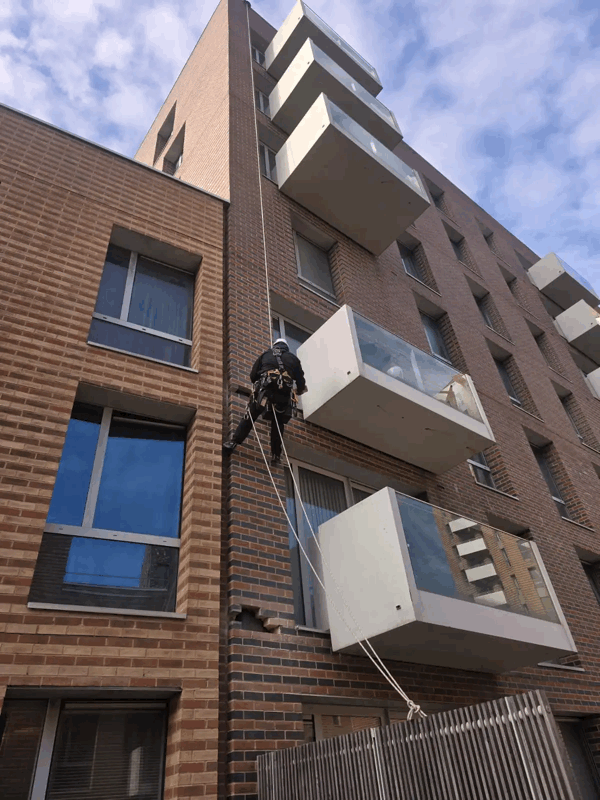
Climbers are industrial rope access technicians who provide essential access to high or restricted areas of a building's facade for the purposes of intrusive cladding inspections, material sampling, and technical facade repairs.
Last updated
On this page
Climbers
Definition and Professional Context
In the context of the UK building envelope and facade industry, "climbers" refers to specialist operatives who access high or difficult-to-reach parts of a building. While the term may evoke imagery of recreational activity, in a professional engineering and surveying capacity, it denotes industrial rope access technicians. These individuals are trained to descend, ascend, and traverse building elevations using specialized rope systems and harnesses to perform technical tasks where traditional access methods—such as scaffolding, mast climbers, or mobile elevating work platforms (MEWPs)—are impractical, cost-prohibitive, or physically impossible.
Within the cladding sector, these operatives are rarely generalists; they typically possess specific competencies in facade pathology, intrusive testing, or cladding remediation. Their role is central to the lifecycle of a building’s external wall system (EWS), providing a means to conduct close-quarters inspections that cannot be achieved via ground-based thermal imaging or drone surveys alone.
Role in Cladding Testing and Inspection
The requirement for climbers often arises during the initial assessment phases of a building’s fire safety strategy. Under current UK industry standards, including the PAS 9980 code of practice, a competent professional may require an intrusive inspection to determine the composition of the external wall build-up. Because cladding systems are composed of multiple layers—including the outer rainscreen, insulation, cavity barriers, and substrate—a visual inspection from the ground is insufficient.
Climbers are deployed to perform 'drop' surveys. During these operations, they remove specific panels or sections of the building fabric at various heights to document the internal components. This process allows for the extraction of material samples for laboratory testing and the verification of cavity barrier installation against original architectural drawings. The agility of rope access means that multiple points on a facade can be sampled in a single day, providing a broader data set for the Fire Risk Appraisal of External Walls (FRAEW) without the logistical footprint of fixed scaffolding.
Integration with Building Fabric and External Wall Systems
The interaction between a climber and the building fabric is governed by the structural integrity of the facade and the availability of certified anchor points. Before any rope access work commences, a structural assessment of the roof or the building’s load-bearing elements is typically required. The building fabric must be able to support not only the weight of the operative but also the potential dynamic loads involved in the access method.
For modern rainscreen systems, the presence of climbers is a factor in the long-term maintenance strategy. Certain cladding materials, such as high-pressure laminates (HPL), metal composite materials (MCM), or terracotta tiles, require periodic inspection for signs of delamination, fixings failure, or moisture ingress. Climbers facilitate these granular checks, ensuring that the interface between different materials—such as the transition from a brickwork plinth to a glazed curtain wall—is functioning as intended.
Regulatory and Process Context in England and Wales
The use of rope access in the UK is framed by the Work at Height Regulations 2005. These regulations mandate that work at height must be properly planned, supervised, and carried out in a manner which is, so far as is reasonably practicable, safe. In the specific context of cladding remediation and the Building Safety Act 2022, the role of the climber is often integrated into the "Golden Thread" of building information. The data they collect during inspections forms a critical part of the safety case for higher-risk buildings.
Industry practice typically aligns with the standards set by the Industrial Rope Access Trade Association (IRATA). Technicians are graded from Level 1 to Level 3, with Level 3 being the most experienced supervisor responsible for site safety and rescue protocols. When a building owner commissions cladding work involving climbers, the process generally follows a specific sequence:
| Stage | Activity | Documentation |
|---|---|---|
| Planning | Site survey and anchor point testing | RAMS (Risk Assessment & Method Statement) |
| Access | Rigging of primary and secondary lines | Equipment Log and LOLER Inspection |
| Execution | Intrusive testing or localized repair | Inspection Report and Photographic Evidence |
| Reinstatement | Closing of facade and sealing of samples | Completion Certificate |
Climbers
Considerations for Building Owners and Managers
For Responsible Persons, such as Managing Agents or RMC (Residents' Management Company) Directors, understanding the logistical implications of employing climbers is essential. Unlike scaffolding, which remains fixed for the duration of a project, rope access is a transient activity. This can offer significant advantages in terms of site security and resident privacy, as there are no permanent structures for unauthorized persons to climb.
However, building owners must ensure that the building’s fall protection systems—such as eye-bolts or weighted anchors—are subject to regular testing under the Lifting Operations and Lifting Equipment Regulations 1998 (LOLER). If a building lacks permanent anchors, 'deadweight' anchors or A-frame systems may be used on the roof, provided the roof structure has been cleared for such loads by a structural engineer. The selection of a rope access team should be based on their specific experience with cladding systems, rather than general maintenance, to ensure that the integrity of the external wall is maintained when panels are removed and reinstated.
Common Misunderstandings and Terminology
A frequent misunderstanding is the conflation of "climbers" with "mast climbers." A mast climbing work platform (MCWP) is a mechanical lift that travels vertically on one or more masts, providing a stable platform for multiple workers and heavy materials. In contrast, "climbers" (rope access technicians) operate independently of large machinery, using gravity and manual ascent techniques. While mast climbers are often preferred for large-scale recladding projects where heavy panels must be moved, rope access "climbers" are usually the preferred choice for investigative surveys, minor repairs, or aesthetic cleaning.
Another common misconception is that rope access is inherently more hazardous than other methods. In professional practice, the redundancy built into modern rope systems—where every operative is attached to two independent points—is designed to manage risk effectively.
Related terminology includes:
- Abseiling: The specific technique of descending a rope, often used interchangeably with rope access in non-technical conversation.
- Intrusive Inspection: The process of opening up the building fabric to view internal components, often performed by climbers.
- Anchor Points: The structural fixings to which ropes are attached.
- Cradle: A suspended platform (Building Maintenance Unit or BMU) used for facade access, distinct from rope-based climbing.
The deployment of climbers remains a standard, technical solution for the complex demands of modern UK facade management, particularly where architectural complexity limits the use of traditional access plant.
Climbers