
Glossary · Single word
Existing
In short
currently in place or present; already built or installed
In the UK cladding industry, "existing" refers to the materials and systems currently installed on a building. It serves as the baseline for technical assessments, regulatory compliance audits, and the planning of remedial works for external wall systems.
Last updated
On this page
Existing
Definition and Technical Scope
In the context of the UK built environment and cladding sector, the term "existing" refers to any component, material, or assembly that is currently in place or present within a structure. It denotes the physical reality of a building’s fabric as it stands at a specific point in time, typically prior to any proposed intervention, remediation, or investigative opening-up works. While the term may seem self-evident, its technical application distinguishes between what was originally specified in historical design documents and what is physically present on the facade.
In cladding consultancy, the "existing" state serves as the baseline for all risk assessments and technical evaluations. It encompasses not only the visible outer leaf—such as rainscreen panels or render—but also the concealed elements of the external wall system (EWS), including insulation, cavity barriers, fire stops, sub-frames, and the inner leaf or structural substrate. Establishing the nature of the existing construction is the primary objective of intrusive surveys and technical audits.
Role in Testing and Investigation
The term "existing" is central to the process of cladding investigation, particularly under the protocols established by PAS 9980:2022. When a fire risk appraisal of external walls (FRAEW) is commissioned, the assessor is tasked with evaluating the existing condition of the building. This requires a shift from relying on "as-built" drawings—which may not accurately reflect the final construction—to documenting the actual materials installed.
Investigation of existing systems typically involves:
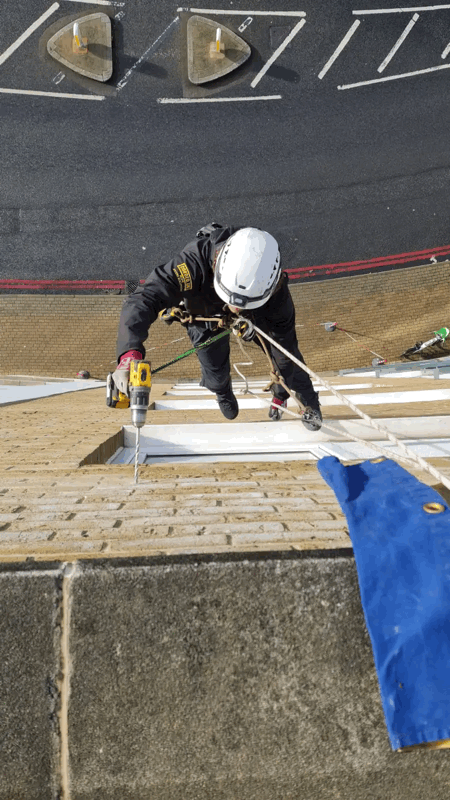
- Intrusive Inspection: Removal of panels to observe the internal composition of the wall.
- Material Identification: Identifying the specific make and model of existing insulation and cladding to determine their reaction-to-fire classifications.
- Condition Surveys: Assessing whether the existing materials have degraded over time due to water ingress, mechanical failure, or poor original installation.
The data gathered regarding the existing facade forms the evidence base for determining whether the current system aligns with the functional requirements of the Building Regulations applicable at the time of construction, or if it necessitates remediation to meet contemporary safety standards for high-rise residential buildings.
Regulatory Context in England and Wales
The regulatory framework in England and Wales places significant emphasis on the distinction between existing structures and new works. Under the Building Safety Act 2022 and the associated secondary legislation, the "existing" state of a building determines its classification and the subsequent duties of the Accountable Person or Principal Accountable Person. For buildings over 18 metres or seven storeys, the existing external wall system must be documented as part of the Safety Case Report.
The transition from the existing state to a remediated state is governed by the Building Regulations. When an existing cladding system is replaced, the new works must typically comply with current requirements, such as the ban on combustible materials in the external walls of relevant buildings, as outlined in Regulation 7(2). However, the existing elements that are retained must be assessed to ensure they do not compromise the performance of the new installation. The concept of "material alteration" is critical here; if work on an existing building affects its compliance with a relevant requirement, the work must be carried out such that the building as a whole is no less compliant than it was before the work commenced.
Existing
Implications for Building Management
For building owners, Managing Agents, and directors of Residents' Management Companies (RMC) or Right to Manage (RTM) companies, understanding the existing fabric is a fiduciary and legal necessity. The existing state of the cladding dictates the valuation of the property, its insurability, and the potential for service charge recovery related to remediation.
When commissioning reports, such as an EWS1 form (External Wall System Fire Review), the professional conducting the assessment is verifying the existing materials. It is common for there to be a discrepancy between the existing materials found during a survey and those listed in the original Operation and Maintenance (O&M) manuals. Where such discrepancies exist, the physical evidence of the existing wall system takes precedence over historical paperwork. Managing parties must therefore ensure that their records reflect the physical reality of the building rather than theoretical specifications.
Common Misunderstandings
A frequent misunderstanding regarding "existing" cladding is the assumption that because a system was compliant at the time of installation, its status remains unchanged regardless of legislative shifts. While many buildings were constructed in accordance with the guidance available at the time, the introduction of new assessment methodologies, such as PAS 9980, requires a contemporary evaluation of the existing risk, which may lead to different conclusions than those reached during the original construction phase.
Another misconception relates to "like-for-like" repairs. In the context of existing cladding, replacing a damaged panel with an identical product is often viewed as simple maintenance. However, if the existing product no longer meets modern safety standards or has been withdrawn from the market, a "like-for-like" replacement may not be permissible or advisable. In these instances, the intervention on the existing facade must be treated as a new work element requiring professional design input.
Related Terminology and Technical Nuance
The term "existing" is often used alongside other specific descriptors to define the lifecycle of a building project. Understanding these distinctions is vital for clear technical communication.
| Term | Technical Application |
|---|---|
| As-Built | Documentation intended to reflect the building as completed, though often inaccurate. |
| Legacy | Refers to systems or materials installed under previous iterations of Building Regulations. |
| Substrate | The existing structural surface to which new cladding or insulation is applied. |
| Retrofit | The process of adding new components to an existing building to improve performance. |
| Remediation | The act of correcting defects or non-compliant elements within the existing fabric. |
Practical Challenges in Assessment
Establishing the baseline of an existing system often presents practical challenges, particularly in older buildings where documentation is missing. In such cases, the "existing" state must be reconstructed through forensic engineering. This may involve laboratory testing of existing core samples to determine the calorific value or chemical composition of the materials.
Furthermore, the existing state is rarely uniform. Over a building's lifespan, various repairs and partial replacements may have occurred, leading to a "patchwork" of different materials within the same facade. A thorough assessment must account for these variations, as the performance of the existing wall system is only as robust as its weakest point. Professionals must therefore ensure that their sampling frequency during surveys is sufficient to capture the true diversity of the existing construction across all elevations.
Existing