
cladding pull out testing
Cladding Pull Out Testing
Ensuring the structural stability of a building envelope requires more than a visual assessment of the exterior panels. Cladding pull out testing is a vital onsite procedure used to measure the physical load-bearing capacity of fixings and anchors within an external wall system. By applying a controlled tensile load to a fastener, engineers can verify that the substrate—whether it be concrete, masonry, or steel—is capable of holding the cladding system securely under environmental stresses such as wind loading and self-weight.
Independent
UK-wide coverage
Survey options
Clear reporting
On this page
Book a cladding pull out testing survey
Ensuring the structural stability of a building envelope requires more than a visual assessment of the exterior panels. Cladding pull out testing is a vital onsite procedure used to measure the physical load-bearing capacity of fixings and anchors within an external wall system. By applying a controlled tensile load to a fastener, engineers can verify that the substrate—whether it be concrete, masonry, or steel—is capable of holding the cladding system securely under environmental stresses such as wind loading and self-weight.
In the UK, this process is fundamental to the safety of high-rise residential and commercial properties. A cladding pull-out test provides the empirical data necessary to confirm that the original design specifications are met or to determine if a deteriorating substrate can still support existing loads. Without this data, building owners and managing agents risk systemic failure, which in extreme cases can lead to the detachment of façade components.
Key Takeaways
- Structural Verification: Pull out testing confirms that anchors can withstand the calculated wind loads and dead loads of the cladding system.
- Substrate Assessment: It identifies whether the base material (e.g., brick, block, or concrete) has deteriorated to the point where fixings are no longer secure.
- Compliance and Safety: Testing is often a mandatory requirement for BS 8539 compliance regarding the installation of post-installed anchors.
- Remediation Planning: The results dictate whether a building requires localised repairs, a new fixing strategy, or a complete recladding programme.
- Risk Mitigation: Regular testing reduces the liability for property managers by providing a documented trail of structural adequacy.
What is a Cladding Pull Out Test?
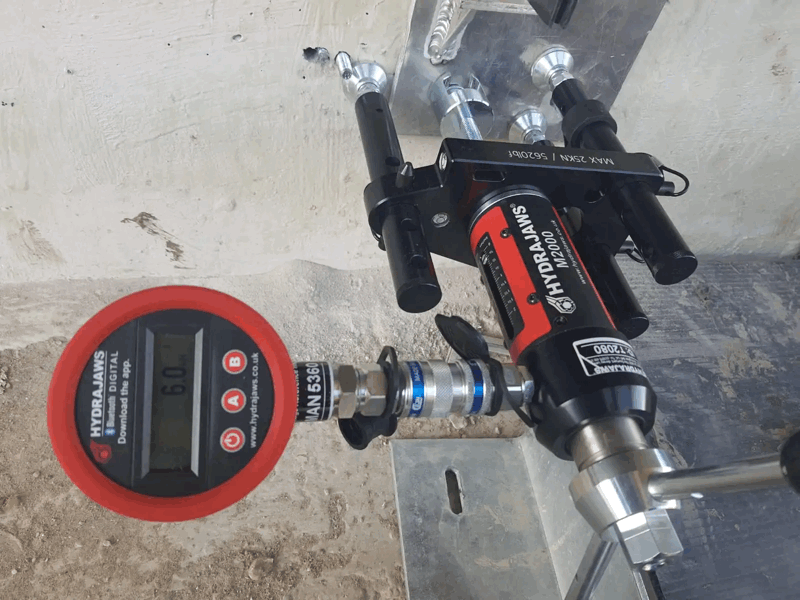
A cladding fixing pull out test is a mechanical assessment where a specialist jack is attached to an installed anchor or bolt. The jack applies a specific amount of tension, pulling the anchor away from the wall. The goal is to determine the "ultimate load" (the point at which the fixing or substrate fails) or to validate a "proof load" (a safe working load predetermined by structural engineers).
This testing is not merely a box-ticking exercise. It is a critical diagnostic tool used during cladding testing and inspection phases to ensure that the "bones" of the façade are healthy. If a fixing pulls out at a lower force than specified, it indicates a failure in either the installation technique, the choice of anchor, or the integrity of the building’s structural frame.
Why Structural Integrity Testing is Essential for UK Façades
The UK’s building stock is diverse, ranging from mid-century reinforced concrete frames to modern steel-stud systems. Over time, environmental factors such as moisture ingress, carbonation in concrete, and freeze-thaw cycles can weaken the substrates that cladding anchors rely on. A cladding anchor pull out test is the only definitive way to measure how these factors have affected the building's safety.
Meeting Regulatory Standards
Following recent changes in building safety legislation, including the Building Safety Act 2022, there is increased scrutiny on the "as-built" condition of external walls. BS 8539:2012 (Code of practice for the selection and installation of post-installed anchors in concrete and masonry) provides clear guidance that testing should be carried out where the strength of the base material is unknown or where the anchor is not covered by a European Technical Assessment (ETA).
Managing Wind Load Risks
High-rise buildings in the UK are subject to significant wind pressures, particularly at the corners and top storeys of the structure. Cladding panels act like sails; they transfer these immense pressures through the fixings into the building structure. If the facade pull out testing reveals that the fixings are underperforming, the risk of panel detachment during a storm increases significantly.
Common Scenarios Requiring Testing:
- New Installations: Validating that the contractor has installed fixings correctly and that the substrate meets the design assumptions.
- Ageing Buildings: Investigating whether masonry or concrete has weakened over decades, potentially loosening the original fixings.
- Change of Use/Refurbishment: When a heavier cladding material (such as stone or terracotta) is being installed onto an existing frame.
- Post-Incident Investigation: If a panel has become loose or fallen, testing the surrounding anchors is the first step in a wider safety audit.
The Technical Process: How Pull Out Testing is Conducted
At CladdingTesting.com, we approach every building individually. The methodology for cladding pull out testing must be precise to ensure the data is actionable. The process generally follows a structured sequence to ensure both technician safety and data accuracy.
1. Site Preparation and Access
For high-rise buildings, access is often the most complex part of the project. Depending on the building's height and design, we may use mast climbers, cradles, or mobile elevating work platforms (MEWPs). In some cases, industrial rope access (abseiling) is the most efficient method for conducting a cladding fixing pull out test across multiple elevations without the need for extensive scaffolding.
2. Selection of Test Points
Testing every single anchor on a building is neither practical nor necessary. Instead, we use a statistically significant sampling plan. We focus on:
• Different substrate types across the building.
• High-stress areas, such as building corners and parapets.
• A variety of heights to account for different weather exposure levels.
3. The Pull-Out Procedure
A calibrated hydraulic pull-out tester is attached to the anchor. The load is increased gradually while the displacement is monitored. We typically perform two types of tests:
Proof Tests: The anchor is loaded to a predetermined force (usually 1.5 times the design load) to ensure it holds without movement.
Destructive Tests: The anchor is pulled until it fails. This is used to determine the maximum capacity of the substrate and is usually performed on non-critical or sacrificial fixings.
4. Data Recording and Analysis
Every test is recorded with its exact location, the load achieved, and the nature of the failure (if any). Failures aren't always the anchor snapping; often, the substrate itself "cones" out or the anchor slips. This distinction is vital for our engineers to determine whether the fix identifies a need for a different anchor type or more extensive remediation of the wall itself.
Interpreting Results: When Should You Be Concerned?
A single failed test does not always mean the building is unsafe, but it does require immediate investigation. When cladding pull out testing results fall below the required safety margins, we categorise the findings to help managing agents prioritise their response.
Satisfactory Results
If all tested fixings meet the proof load with negligible displacement, the system is deemed structurally sound. We provide a full technical report which can be used for insurance purposes, building safety cases, and EWS1 assessments.
Marginal Failures
If fixings hold the load but show excessive movement, it may suggest that the anchors were not installed to the correct depth or that the substrate is softer than expected. In these cases, we might recommend increasing the frequency of fixings or switching to a longer anchor to reach more stable material.
Systemic Failure
If multiple fixings fail at loads significantly below the design requirement, it indicates a systemic issue. This could be due to widespread "spalling" of concrete, rotten timber battens, or corroded steelwork. In these scenarios, CladdingTesting.com works with the client to develop a remediation or replacement strategy, ensuring the building remains safe while a long-term solution is engineered.
Challenges in High-Rise Testing and Remediation
Testing a two-storey office block is vastly different from conducting facade pull out testing on a 20-storey residential tower. The logistics and risks associated with tall buildings require a specialist approach.
Resident and Tenant Disruption
Many of the buildings we work on are fully occupied. We understand the importance of clear communication and minimising noise. Because pull-out testing is a relatively "clean" and quick procedure compared to full panel removal, it is often a preferred first step in a diagnostic survey as it causes minimal disturbance to residents.
Interface with Other Systems
Cladding fixings do not exist in isolation. They are often part of a complex build-up including insulation, vapour membranes, and cavity barriers. Our team ensures that when we access a fixing for a cladding anchor pull out test, we do not compromise the integrity of the fire stopping or the weather seal. Any penetrations made for testing are professionally reinstated.
Environmental Factors
On tall buildings, wind speeds at height can be significantly higher than at ground level. Our teams monitor weather conditions constantly. Testing cannot be safely or accurately performed in high winds, as the movement of the access equipment can interfere with the sensitive hydraulic readings of the test equipment.
Book a cladding pull out testing survey
Choosing Between Repair, Remediation, and Replacement
One of the core values of CladdingTesting.com is providing a balanced, evidence-based recommendation. We do not believe in a "one size fits all" approach that defaults to total recladding. The data from cladding pull out testing is a primary factor in this decision-making process.
When Repair is Possible
If the testing shows that the vast majority of the building is sound, but specific areas (such as a single elevation exposed to prevailing winds) are showing weakness, localized repairs are often the most sensible route. This might involve replacing specific fixings with high-performance resin anchors or adding supplementary brackets to reinforce the system.
When Remediation is Required
Remediation is often necessary when the fixings are sound, but the components they are holding (like the rails or brackets) show signs of corrosion or fatigue. It involves a more comprehensive overhaul than a simple repair but stops short of a full strip-off. We might remediate the fixing points across a whole floor or section of the building to bring it back to a certifiable standard.
When Complete Replacement is Necessary
Full recladding is typically the result of several factors converging:
• The substrate is too weak to support any safe fixing.
• The existing cladding material is non-compliant (e.g., combustible ACM).
• The cost of individual repairs across the whole façade exceeds the cost of a new, modern system.
In these cases, the initial cladding pull-out test serves as the justification for the capital expenditure, providing the "proof" needed for funding applications or legal claims.
The Impact of the Building Safety Act on Testing Cycles
The regulatory landscape in the UK has shifted. Under the new regime, the "Accountable Person" for a high-risk building must demonstrate that they are managing building safety risks effectively. A proactive programme of cladding pull out testing is a powerful tool in demonstrating this due diligence.
Rather than waiting for a problem to manifest, many of our clients now include structural fixing assessments as part of their 5-year or 10-year façade maintenance cycles. This allows for small issues—like the early stages of anchor corrosion—to be caught before they require expensive, large-scale intervention.
Insurance and Liability
Insurance providers are increasingly asking for evidence of structural adequacy for external wall systems. A documented history of facade pull out testing can help in negotiating premiums and provides a clear defence in the event of a structural claim. It shows that the building owner has taken reasonable steps to ensure the safety of the public and the residents.
Common Misconceptions About Pull Out Testing
In our experience, there are several myths regarding cladding fixing pull out test procedures that can lead to confusion for property managers.
"It will damage my building"
While destructive testing does involve pulling a fixing until it fails, this is only done on a very small number of points. Most testing is "non-destructive" proof testing. The equipment is designed to apply force only to the anchor, and any small holes required for access are carefully repaired to be watertight and aesthetically matching.
"Visual inspections are enough"
A visual inspection can spot a cracked panel or a missing bolt, but it cannot see "inside" the wall. It cannot detect a resin anchor that hasn't cured properly or a bolt that has been stripped inside a masonry unit. Cladding pull out testing provides the invisible data that eyes cannot see.
"New buildings don't need testing"
Installation errors are one of the leading causes of cladding failure. Even in brand-new constructions, "as-built" testing is essential to verify that the subcontractors followed the design specifications and that the anchors were installed with the correct torque and depth.
Technical Specifications and Equipment
To deliver accurate cladding pull out testing, we use industry-standard equipment that is calibrated annually by UKAS-accredited laboratories. Our technicians are trained to understand the nuances of different anchor types.
Types of Anchors We Test:
- Mechanical Expansion Anchors: Commonly used in solid concrete; these rely on friction against the hole walls.
- Undercut Anchors: High-performance fixings that lock into a pre-cut shape for maximum security.
- Resin/Chemical Anchors: Used in masonry or weaker substrates where a stress-free fixing is required.
- Screw Fixings: Often used in steel-frame systems (SFS) to secure the cladding rails.
For each of these, the failure mode is different. A resin anchor might fail due to improper hole cleaning (dust preventing a bond), whereas a mechanical anchor might fail because the concrete substrate was too "green" (not fully cured) at the time of installation. Our expertise allows us to diagnose these specific causes during the cladding anchor pull out test.
Frequently Asked Questions
How many tests are required for a standard building?
There is no fixed number, but BS 8539 generally recommends a minimum of 5 tests or 5% of the total number of fixings (whichever is greater) for proof testing. However, for large high-rise projects, a bespoke sampling strategy is usually developed by a structural engineer based on the complexity and condition of the building.
Can pull out testing be done in the winter?
Yes, but with caveats. If resin anchors are being tested, the temperature can affect their performance. Furthermore, access via cradles or abseiling is strictly weather-dependent. We plan our cladding pull-out test schedules to account for the UK climate, ensuring safety and data integrity.
What happens if the fixings fail the test?
If a failure occurs, we first investigate the cause. Is it a localized issue or a systemic one? We then offer a range of solutions, from increasing the number of fixings to specifying a different anchor technology. Our goal is to find the most cost-effective way to ensure the building is safe.
How long does a typical test take?
The physical act of pulling an anchor takes only a few minutes. However, the majority of the time is spent on safe access, setup, and precise measurement. A team can typically perform between 10 and 20 tests a day depending on the access methods used.
Do I need testing for my EWS1 form?
While an EWS1 (External Wall System) assessment focuses heavily on fire safety and material combustibility, the structural integrity of the system is often a supporting requirement. If a surveyor has concerns about the stability of the cladding, they will likely request cladding pull out testing before they are willing to sign off on the safety of the wall.
Is this the same as a "shear test"?
No. A pull-out test measures tensile strength (pulling out of the wall). A shear test measures the strength of the fixing against vertical force (sliding down the wall). While both are important, pull-out resistance is usually the more critical factor for wind-load safety in cladding systems.
Professional Reporting and Next Steps
Following the completion of cladding pull out testing, CladdingTesting.com provides a comprehensive technical report. This is not just a list of numbers. It includes:
• Photo documentation of each test site.
• Calibration certificates for the equipment used.
• A site map showing the location of all tests.
• A detailed analysis of any failures.
• Practical recommendations for repair, remediation, or replacement.
For building owners and managing agents, this report is a vital document. It provides the clarity needed to make informed decisions about the building’s future. Whether the results confirm that the building is safe or highlight the need for a major recladding project, you will have the technical evidence required to move forward with confidence.
If you are responsible for a building and have concerns about the structural integrity of its façade, or if you require facade pull out testing as part of a planned maintenance programme, contact CladdingTesting.com today. Our team of specialists will help you navigate the technical and regulatory requirements, ensuring your building remains safe, compliant, and structurally sound for the long term.
Book a cladding pull out testing survey
What it costs
Pricing depends on building height, access and scope
Reviews
What clients say
Verified 5-star Google reviews from building owners, managing agents and contractors.