
Glossary · Two-word term
Mast Climbers
In short
powered platforms used for working at height on building facades
Mast climbers are powered vertical platforms used to provide access to building facades for cladding inspection and remediation. Unlike static scaffolding, they move along fixed masts, offering a high-capacity, modular solution for working on high-rise external wall systems.
Last updated
On this page
Mast Climbers
Definition and Technical Overview
Mast climbers, formally known as Mast Climbing Work Platforms (MCWPs), are powered lifting systems designed to provide temporary access to the external facades of buildings. Unlike traditional tube-and-fitting scaffolding, which relies on a dense network of structural frames anchored to the ground and the building, an MCWP consists of a platform that travels vertically along one or more stationary masts. These masts are typically modular steel lattice sections bolted together and tied to the building's primary structure at regular intervals to provide lateral stability.
The mechanism generally employs a rack-and-pinion drive system, allowing the platform to be raised and lowered to precise heights. In the context of the UK cladding industry, these systems are categorised as single-mast or twin-mast configurations. Single-mast units are suitable for narrower elevations, while twin-mast units support longer platforms, often extending to 30 metres or more, allowing larger sections of the building envelope to be accessed simultaneously.
Application in Cladding Remediation and Testing
In the lifecycle of a building's external wall system (EWS), mast climbers are frequently deployed during the intrusive inspection and remediation phases. During the initial assessment of a high-rise building, an MCWP may be used to facilitate the removal of cladding panels for sampling or to allow a fire engineer to inspect the underlying cavity barriers and insulation.
When large-scale replacement of combustible materials is required, mast climbers often serve as the primary means of access. Their ability to carry significant payloads—including heavy replacement panels, mineral wool insulation, and multiple personnel—makes them an efficient alternative to traditional scaffolding for high-rise projects. They are particularly prevalent in projects where the structural integrity of the ground cannot support the weight of a full scaffolding rig, or where the footprint for equipment is limited.
Interaction with Building Fabric and EWS
The relationship between a mast climber and the building fabric is critical. The system requires 'ties'—mechanical anchors that fix the masts to the building’s structural frame (such as the concrete floor slabs or steel columns). The positioning of these ties must be carefully coordinated with the layout of the cladding system. If the building is undergoing a full reclad, the sequence of work must account for the areas where ties penetrate the new facade; these 'leave-outs' are typically finished once the mast climber is dismantled.
Furthermore, the platform's proximity to the external wall must be managed to ensure the safety of operatives while preventing damage to new cladding finishes. Because MCWPs are dynamic systems, they impose different structural loads on the building compared to static scaffolding. A structural engineer usually assesses the building’s capacity to withstand these localised point loads at the tie-in locations before installation begins.
Regulatory Context in England and Wales
The use of mast climbers in the UK is governed by several layers of health and safety legislation and technical standards. The primary overarching regulation is the Work at Height Regulations 2005, which requires that all work at height is properly planned, supervised, and carried out by competent persons. Because MCWPs are classified as lifting equipment, they also fall under the Lifting Operations and Lifting Equipment Regulations 1998 (LOLER) and the Provision and Use of Work Equipment Regulations 1998 (PUWER).
Under LOLER, mast climbers must undergo thorough examinations by a 'competent person' at specified intervals—typically every six months, or following any major alteration or incident. Furthermore, the British Standard BS 7981 provides a code of practice for the installation, maintenance, examination, and use of MCWPs. Compliance with these standards ensures that the equipment is fit for purpose and that the risks associated with vertical transport on a building facade are managed according to industry best practice.
Mast Climbers
Considerations for Building Owners and Managers
For Responsible Entities, including Residents' Management Companies (RMCs) and Right to Manage (RTM) directors, the decision to use mast climbers involves several logistical and financial considerations. While MCWPs can often be installed more quickly than traditional scaffolding and offer less visual obstruction for residents, they do not provide the same level of 'wrap-around' access.
| Feature | Mast Climbing Work Platforms (MCWP) | Traditional Tube-and-Fitting Scaffolding |
|---|---|---|
| Footprint | Minimal; concentrated at mast bases | Extensive; covers the building perimeter |
| Visual Impact | Low; platform moves with the work | High; entire facade is obscured |
| Security | Higher; platform can be parked at height | Lower; provides ladders/stairs to all levels |
| Loading | High capacity for heavy materials | Limited by board and transoms |
| Flexibility | Best for vertical/linear facades | Best for complex shapes and corners |
Managing agents must also consider the impact on building occupants. Although mast climbers allow for more natural light to enter windows compared to scaffold netting, the noise of the drive motors and the presence of a moving platform outside windows are factors that require clear communication with residents.
Common Misunderstandings and Closely Related Terminology
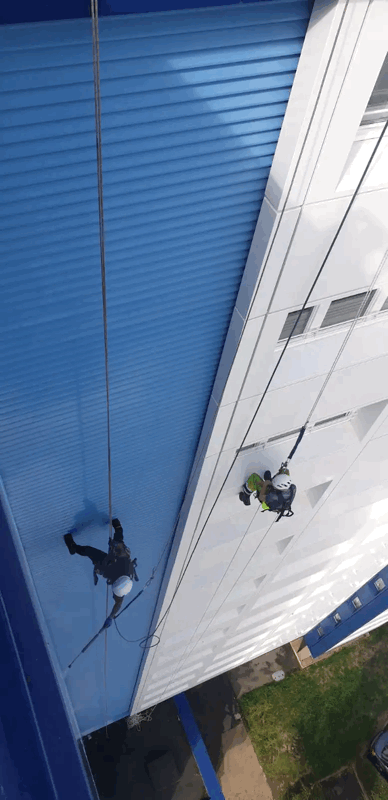
A frequent misunderstanding is the confusion between mast climbers and suspended access equipment (commonly known as 'cradles' or Building Maintenance Units). While both provide access to facades, a mast climber is supported from the ground or a structural base and moves along a rigid mast, whereas a cradle is suspended via wire ropes from a roof-mounted rig. Cradles generally have much lower load capacities and are more susceptible to movement in windy conditions.
Another common point of confusion relates to 'hoists'. While both involve vertical transport, a goods or passenger hoist is typically an enclosed car used for moving people and materials between floors, whereas a mast climber is an open-air working platform designed for performing tasks directly onto the facade while stationary.
Related terminology includes:
- Tie-in: The mechanical connection between the mast and the building structure.
- Outrigger: Extensions to the platform deck used to reach around architectural features.
- Base Frame: The structural foundation that supports the weight of the masts and the platform.
- Buffer: A safety device at the bottom of the mast to prevent the platform from striking the ground in the event of a descent limit failure.
The selection of an access strategy is a bespoke process. A competent professional, such as a facade consultant or a principal contractor, must determine whether a mast climber is the most appropriate solution based on the building’s height, shape, structural capacity, and the specific requirements of the cladding works being undertaken.
Mast Climbers