
Glossary · Two-word term
Industrial Rope
In short
specialised ropes and harnesses used by trained operatives for building access
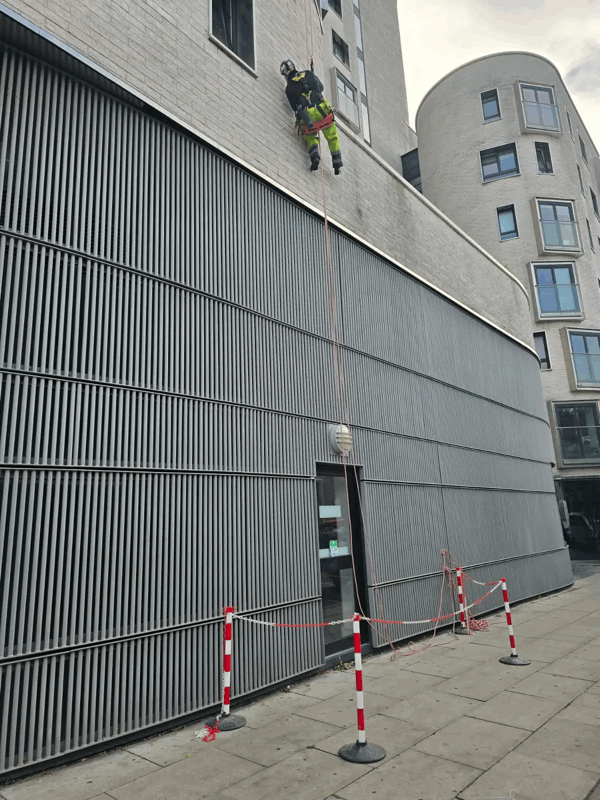
Industrial rope refers to the specialised two-rope systems and harnesses used by trained technicians to access building elevations. It is a common method for conducting cladding inspections, intrusive testing, and minor repairs on high-rise structures across the UK.
Last updated
On this page
Industrial Rope
Definition and Application of Industrial Rope
In the context of the UK built environment, the term "industrial rope" refers to specialised, high-strength ropes and harnesses utilised by trained operatives to facilitate vertical access to building elevations. Often categorised under the broader heading of "rope access," this method allows technicians to reach external wall systems, cladding panels, and glazing without the requirement for ground-based support structures such as scaffolding or heavy plant machinery.
Industrial rope systems are typically based on a two-rope principle: a primary working line and a secondary safety (or "back-up") line. Each line is independently anchored to the building’s structural frame or designated plant room fixtures. The operative is suspended via a harness and uses mechanical devices to ascend, descend, or position themselves at specific heights. In cladding-specific work, this provides a versatile means of navigating complex geometries or high-rise elevations where traditional access methods may be impractical or cost-prohibitive.
Role in Cladding Testing and Inspection
Industrial rope access is frequently employed during the initial assessment phases of external wall systems (EWS). When conducting an EWS1 assessment or a PAS 9980 appraisal, surveyors often require physical access to the cladding to perform intrusive inspections. This may involve the removal of small sections of panel, the extraction of insulation samples, or the inspection of fire cavity barriers.
The use of industrial rope in this capacity allows for a "multi-drop" approach, where technicians can move laterally and vertically across a façade to sample various elevations. This is particularly relevant for buildings where the cladding material varies by floor or orientation. Because rope access requires minimal set-up time compared to mast climbers or scaffolding, it is often the preferred method for localized testing where the objective is to gather data rather than execute a full-scale replacement.
Interface with External Wall Systems (EWS)
The relationship between industrial rope and the building fabric is one of physical interaction and weight distribution. When rope access is utilised, the load is transferred through the anchors to the building’s primary structure, rather than the cladding itself. It is a fundamental principle of the discipline that operatives do not rely on the external cladding panels for support, as these components are typically designed for wind loading rather than vertical point loads.
For building owners, the integrity of the external wall system must be considered when planning rope-based works. High-pressure laminates (HPL), aluminium composite materials (ACM), and render systems all have different tolerances for abrasion. While the ropes themselves are static, protective measures such as edge protectors or "rollers" are standard industry practice to ensure the rope does not damage the cladding profile or the weather seals at the panel joints.
Regulatory and Process Context in England and Wales
The use of industrial rope is governed by a framework designed to manage the risks associated with work at height. In England and Wales, the primary statutory instrument is the Work at Height Regulations 2005. These regulations mandate a hierarchy of control, requiring that work at height is avoided where possible, and that where it cannot be avoided, equipment is used to prevent falls.
Professional practice is further defined by BS 7985 (Code of practice for the use of rope access methods for industrial purposes) and the technical standards set by trade bodies such as IRATA (Industrial Rope Access Trade Association). These standards stipulate the requirements for operative certification, equipment inspection intervals, and the necessity of a detailed, site-specific Risk Assessment and Method Statement (RAMS). A crucial regulatory requirement is the presence of a rescue plan; unlike scaffold-based work, rope access teams must be capable of performing a "self-rescue" or peer-recovery without total reliance on emergency services.
Industrial Rope
Considerations for Building Owners and Managers
Building owners, Managing Agents, and Residents' Management Company (RMC) directors must treat industrial rope access as a specialised contracted service. While it often represents a lower visual impact and reduced security risk compared to scaffolding—as equipment is typically removed from the face of the building at the end of each shift—it requires specific administrative oversight.
| Consideration | Detail |
|---|---|
| Anchor Points | Verification of tested and certified Class A1 anchor bolts or weighted deadweight anchors. |
| Exclusion Zones | Requirement for cordoned areas at ground level to protect the public from falling objects. |
| Certification | Review of LOLER (Lifting Operations and Lifting Equipment Regulations) inspection reports for all gear. |
| Weather Constraints | Operability is strictly limited by wind speeds and thermal conditions (ice/excessive heat). |
Furthermore, when industrial rope is used for cladding repair or replacement, the weight and size of the panels being handled are limited by the safe working load of the rope systems. While small-scale panel replacement is common, large-format or heavy masonry units may require alternative mechanical lifting assistance.
Common Misunderstandings
A frequent misconception is that industrial rope access is inherently more hazardous than other forms of work at height. Statistically, within the UK, the rigorous training and two-point attachment requirements result in a high safety record relative to traditional ladder or mobile tower usage. However, this safety is contingent upon the competency of the specific team and the suitability of the building’s anchorage points.
Another misunderstanding involves the impact on building insurance. Some stakeholders assume that rope access work automatically increases premiums; in practice, provided the contractors are suitably insured and follow the recognized British Standards, it is a standard industry procedure. Finally, it is often incorrectly assumed that rope access can be used on any building. In reality, buildings with fragile roof structures, lack of structural anchor points, or significant "overhangs" may be unsuitable for this method.
Related Terminology
Understanding industrial rope requires familiarity with several related terms used by surveyors and façade engineers:
- Abseiling: The recreational term for descending a rope, though in a professional context, "rope access" is preferred to denote the two-rope safety system.
- A-Frame / Deadweight Anchor: Portable anchoring systems used when a building lacks permanent eyebolts or structural attachment points.
- Drop: A single vertical line of descent; a survey might be quoted based on the number of "drops" required to cover the building’s perimeter.
- Lanyard: A short length of rope used to secure tools to the technician’s harness, preventing the risk of "dropped objects."
- Lifting Operations and Lifting Equipment Regulations (LOLER): The UK regulations that dictate how often ropes and harnesses must be formally inspected by a "competent person."
The choice between industrial rope and other access methods—such as cradles (Suspended Access Equipment) or Mobile Elevated Work Platforms (MEWPs)—depends on a variety of factors including building height, site footprint, and the specific nature of the cladding intervention required. A competent professional should always be consulted to determine the most appropriate access strategy for a specific external wall project.
Industrial Rope