
Glossary · Two-word term
Cladding Testing
In short
assessment of cladding materials to determine fire performance and other characteristics
Cladding testing involves the technical assessment of external wall materials and systems to determine fire performance and structural characteristics, providing the empirical evidence required for building safety valuations and remediation planning within the UK regulatory framework.
Last updated
On this page
Cladding Testing
Definition and Technical Scope
In the context of the UK built environment, cladding testing refers to the systematic assessment of cladding materials and wider external wall assemblies to determine fire performance, structural integrity, and various physical characteristics. While the term is often used colloquially to describe the removal and laboratory analysis of material samples, it encompasses a broad spectrum of investigative methods. These range from bench-scale component testing, such as small-scale combustibility assessments, to large-scale system tests that evaluate how multiple components—including insulation, rails, fixings, and fire breaks—interact under specific conditions.
The primary objective of cladding testing is to gather empirical data regarding the performance of the external wall system. This data informs the technical assessments required for building safety, insurance, and valuation. It is a critical component of the due diligence process for high-rise residential buildings (HRBs) and other complex structures, ensuring that the materials present match the original design specifications or identifying the presence of unforeseen components within the build-up.
Application in Repair and Replacement
Cladding testing is typically the foundational stage of any remediation or repair project. Before a replacement strategy can be formulated, a competent professional must ascertain the exact composition of the existing wall system. This process often involves intrusive inspections, where sections of the cladding are removed to allow for the inspection of the internal cavity.
During the repair or replacement phase, testing may serve several functions:
- Verification: Ensuring that materials delivered to a site correspond with the manufacturer’s technical data sheets and the project specifications.
- Performance Benchmarking: Testing new, proposed systems against established standards (such as BS 8414) to confirm they meet the design intent.
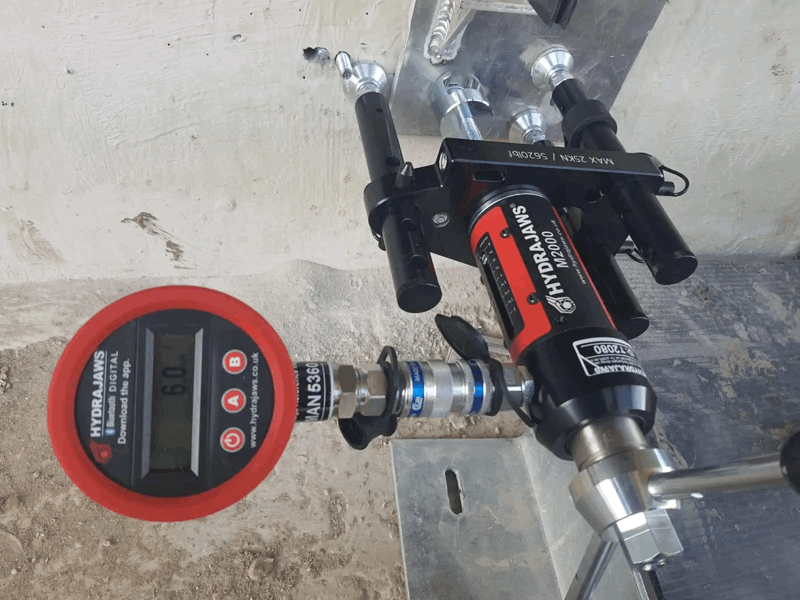
- Quality Control: Post-installation testing, such as pull-out tests for fixings or weather-tightness testing, to ensure the replacement system has been installed correctly and will perform as expected over its design life.
Integration with Building Fabric and EWS
The term "cladding" is often used as a shorthand, but cladding testing rarely focuses solely on the outermost rainscreen. Instead, it addresses the entire External Wall System (EWS). The building fabric is a complex assembly where the performance of one element is intrinsically linked to another. For instance, the fire performance of an Aluminium Composite Material (ACM) or High Pressure Laminate (HPL) panel cannot be fully understood without considering the type of insulation behind it and the presence or absence of effective cavity barriers.
Testing protocols often distinguish between 'material' testing and 'system' testing. Material testing involves isolated analysis of a single component—such as determining the calorific value of an insulation core. System testing, by contrast, examines the holistic performance of the assembly. This is vital because the way heat, moisture, and air move through the building fabric depends on the interface between these different layers. Consequently, cladding testing reports must be interpreted by qualified fire engineers or building surveyors who understand these systemic interdependencies.
Cladding Testing
Regulatory and Process Context in England and Wales
The regulatory landscape for cladding testing in England and Wales is defined by the Building Regulations and, more recently, the Building Safety Act 2022. The emphasis has shifted towards a rigorous 'Golden Thread' of information, where the physical reality of the building must be documented and evidenced. Cladding testing provides the empirical evidence required for this documentation.
In the current process, the EWS1 (External Wall System) survey is a common trigger for cladding testing. While the EWS1 is a valuation tool rather than a statutory requirement, it frequently necessitates intrusive testing to allow a professional to sign the form. Furthermore, the Fire Safety (England) Regulations 2022 and the functional requirements of the Building Regulations (specifically Requirement B4) dictate that the external walls of a building shall adequately resist the spread of fire. Cladding testing is the mechanism by which professionals gather the data necessary to judge whether a building meets these functional requirements.
| Test Type | Focus Area | Standard (Example) |
|---|---|---|
| Reaction to Fire | Flammability and smoke | EN 13501-1 |
| Full-scale System Test | Fire spread over external walls | BS 8414 |
| Intrusive Inspection | Cavity barriers and fixings | PAS 9980 methodology |
| Bomb Calorimetry | Material calorific value | ISO 1716 |
Considerations for Building Stakeholders
For building owners, managing agents, and Residents' Management Company (RMC) directors, understanding the necessity and limitations of cladding testing is essential for effective asset management. Testing is not a one-time event but a diagnostic process. Stakeholders should be aware that initial visual inspections are often insufficient; intrusive sampling is frequently required to identify 'hidden' risks, such as combustible sarking felts or incorrectly installed fire stopping.
It is also important to recognise that testing results are specific to the samples taken. In large or complex buildings, materials may vary across different elevations or floor levels due to historical repairs or variations in original construction. Therefore, a robust testing regime must be statistically significant and overseen by a competent person—typically a chartered engineer or a specialist surveyor—who can interpret the findings within the context of the building’s overall fire strategy.
Common Misunderstandings
A frequent misunderstanding is the belief that a 'cladding test' provides a simple 'pass' or 'fail' certificate for the entire building. In reality, testing produces data points—such as a reaction-to-fire classification (e.g., A2-s1, d0) or a report on the condition of cavity barriers. These data points are then used as inputs for a holistic fire risk appraisal of external walls (FRAEW) under PAS 9980.
Another common misconception is that testing a single panel is sufficient to categorise the whole building. Variations in manufacturing batches or the presence of different insulation types behind identical-looking panels can lead to misleading results if sampling is not comprehensive. Furthermore, stakeholders sometimes confuse 'combustibility' with 'fire risk'; while testing determines the former, the latter is a broader professional judgement that considers factors like building height, occupancy type, and means of escape.
Related Terminology
To navigate the technical documentation associated with cladding testing, it is helpful to understand several closely related terms:
- FRAEW (Fire Risk Appraisal of External Walls): A comprehensive assessment carried out according to the PAS 9980 code of practice, which uses testing data to evaluate the risk to occupants.
- Reaction to Fire: A measure of how a material contributes to the development of a fire (e.g., how easily it ignites).
- Fire Resistance: A measure of how long a component (like a fire door or a floor slab) can withstand a fire and prevent it from passing through.
- Combustibility: The tendency of a material to burn; often classified via the Euroclass system from A1 (non-combustible) to F.
- Intrusive Inspection: The physical act of opening up the building envelope to inspect internal components, which usually precedes or accompanies cladding testing.
Cladding Testing