
HPL cladding remediation
HPL Cladding Remediation
HPL cladding remediation refers to the systematic process of investigating, removing, or modifying external wall systems that incorporate High-Pressure Laminate panels. In the UK, this work is typically driven by the need to ensure building safety and compliance with the Building Safety Act and updated Fire Safety Regulations. The process involves identifying combustible materials, assessing the risk to the building envelope, and implementing engineered solutions to achieve a non-combustible or fire-safe finish.
Independent
UK-wide coverage
Survey options
Clear reporting
On this page
Book a hpl cladding remediation survey
HPL cladding remediation refers to the systematic process of investigating, removing, or modifying external wall systems that incorporate High-Pressure Laminate panels. In the UK, this work is typically driven by the need to ensure building safety and compliance with the Building Safety Act and updated Fire Safety Regulations. The process involves identifying combustible materials, assessing the risk to the building envelope, and implementing engineered solutions to achieve a non-combustible or fire-safe finish.
Key Takeaways
- Safety First: The primary driver for HPL remediation is the replacement of combustible materials with non-combustible alternatives (Euroclass A1 or A2-s1, d0).
- Holistic Assessment: Remediation is not just about the panels; it involves inspecting the insulation, cavity barriers, and substrate.
- Regulatory Compliance: All works must align with the Building Safety Act 2022 and current Building Regulations (Approved Document B).
- Expert Led: Successful projects require a multidisciplinary approach involving fire engineers, specialist contractors, and surveyors.
- Resident Focus: For occupied buildings, logistics and communication are as critical as the technical construction work.
Understanding High-Pressure Laminate (HPL) in the UK Market
High-Pressure Laminate (HPL) is a decorative façade material manufactured by layering paper or wood fibres with thermosetting resins, bonded under high pressure and temperature. While prized for its aesthetic versatility and durability, many legacy HPL systems installed on UK high-rise buildings contain significant organic content, making them potentially combustible.
Following the review of building safety post-2017, HPL cladding became a focus for residential and commercial property owners. The risk profile of combustible HPL cladding varies depending on the core type—specifically whether it is a standard grade or a fire-retardant (FR) grade—and how it was integrated into the original external wall system.
At CladdingTesting.com, we approach these projects by first determining the exact composition of the panels and the underlying wall build-up. It is rarely enough to simply look at the surface; a thorough cladding testing programme is essential to understand the risks hidden behind the decorative façade.
The Composition of HPL Panels
HPL panels are generally classified into three categories based on their reaction to fire. Standard HPL is highly combustible and often fails to meet the safety requirements for tall buildings. Fire-retardant (FR) HPL offers better performance but may still not meet the stringent Euroclass A1 or A2 requirements now mandated for buildings over 11 or 18 metres in specific categories.
The "High Pressure" element of the manufacturing process creates a very dense, hard-wearing material. However, because the primary component is often cellulose (paper/wood), the fuel load it adds to a building’s exterior can be substantial if not managed correctly with adequate cavity barriers and non-combustible insulation.
The Regulatory Landscape for HPL Cladding Remediation
The legal framework surrounding high pressure laminate cladding remediation has evolved rapidly. The introduction of the Building Safety Act 2022 and the Fire Safety (England) Regulations 2022 has placed a clear duty on "Accountable Persons" and "Principal Accountable Persons" to manage building safety risks.
In the UK, the focus is on buildings above 18 metres (or seven storeys) and, increasingly, those between 11 and 18 metres. For these structures, the presence of combustible HPL often necessitates a comprehensive remediation strategy to satisfy insurers, mortgage lenders, and the Building Safety Regulator (BSR).
Approved Document B and Euroclass Ratings
Current Building Regulations require that for "relevant buildings" over 18 metres, external wall materials must achieve Euroclass A2-s1, d0 or A1. Most HPL products struggle to meet this threshold, as they typically achieve Class B or C. This discrepancy is the fundamental trigger for HPL cladding removal in high-rise residential blocks.
Remediation is not always a choice; it is often a requirement for obtaining an EWS1 (External Wall System) form with a satisfactory rating. Without a clear path to remediation, many leaseholders find their properties unmortgageable, and building owners face escalating insurance premiums.
Identifying the Need for Remediation
How do you know if your building requires HPL cladding remediation? The process begins with a professional assessment. We frequently find that HPL is used in combination with other materials, such as ACM (Aluminium Composite Material) or timber, complicating the risk profile.
Signs Your Building Needs Assessment:
- The building was constructed or refurbished between 2000 and 2017 using HPL panels.
- An initial Fire Risk Appraisal of External Walls (FRAEW) has identified combustible materials.
- Lenders are requesting an EWS1 form for apartment sales within the block.
- Visible signs of panel delamination, warping, or failed fixings are present.
Our team at CladdingTesting.com performs intrusive inspections to verify the "as-built" condition. This involves taking small samples of the HPL for laboratory analysis and using borescope cameras to inspect the cavity behind the panels for the presence of fire breaks and compliant insulation.
The Role of the FRAEW (PAS 9980)
The PAS 9980 methodology is the current standard for assessing the fire risk of external walls. Unlike previous binary "pass/fail" tests, a PAS 9980 assessment looks at the building as a whole, including its height, fire strategy, and occupancy. This assessment often dictates whether HPL cladding replacement is necessary or if less intrusive remediation measures can suffice.
Options for HPL Remediation: Repair vs. Replacement
A common misconception is that all HPL must be stripped immediately. While this is often the case for high-rise buildings, our role is to provide a nuanced, technically sound recommendation based on the specific building's context.
1. Localised Repair and Fire Stopping
In rare instances, if the HPL is found to be of a high fire-retardant grade and the building is of lower height, remediation might focus on upgrading the internal fire stopping. This could involve installing new cavity barriers or replacing combustible insulation while retaining the outer HPL skin. However, this is increasingly difficult to justify for buildings over 18 metres under current guidance.
2. HPL Cladding Removal and Partial Remediation
For buildings with mixed-use façades, it may be possible to remove HPL only from high-risk areas, such as escape routes or near balconies, and replace it with non-combustible panels. This "targeted remediation" can be more cost-effective but requires rigorous sign-off from fire engineers and building control.
3. Full HPL Cladding Replacement (Recladding)
For the majority of high-rise residential blocks, the safest and most commercially viable long-term solution is a full recladding project. This involves the complete removal of the combustible HPL cladding and the installation of a new, fully compliant system. This typically includes:
- Non-combustible panels (Solid Aluminium, Stone Wool, or Fibre Cement).
- A1-rated mineral wool insulation.
- Intumescent cavity barriers at all floor levels and around openings.
- New non-combustible supporting sub-frames (rails and brackets).
The Technical Challenges of Remediation Projects
Remediation is significantly more complex than new-build installation. We are working with an existing structure, often with incomplete historical records and hidden defects. The technical challenges require an experienced façade specialist to navigate.
Substrate Condition and Compatibility
Once the HPL panels are removed, we often discover issues with the primary substrate, such as dampness in the light-gauge steel frame (LGSF) or poorly installed vapor membranes. HPL cladding remediation must account for these discoveries. The new cladding system must be compatible with the existing structure’s load-bearing capacity and thermal performance.
Managing the "Golden Thread" of Information
Under the Building Safety Act, we must maintain a "Golden Thread" of information throughout the remediation process. This means documenting every stage: from the initial HPL cladding removal to the specific batch numbers of the new fire-rated insulation. This data is critical for the final building safety case and for future maintenance.
Interface Details
The most common failure points in any façade are the interfaces—where the cladding meets windows, balconies, or rooflines. During remediation, these areas must be carefully detailed to ensure water tightness and fire integrity. We often find that original HPL installations lacked proper flashing or had incorrectly positioned cavity barriers, which we must correct during the remediation phase.
Logistics and Working on Occupied Buildings
Most HPL cladding remediation projects take place while residents are living in the building. This introduces significant logistical constraints that do not exist on a standard construction site. Our approach prioritises safety, privacy, and the minimisation of disruption.
Access Solutions
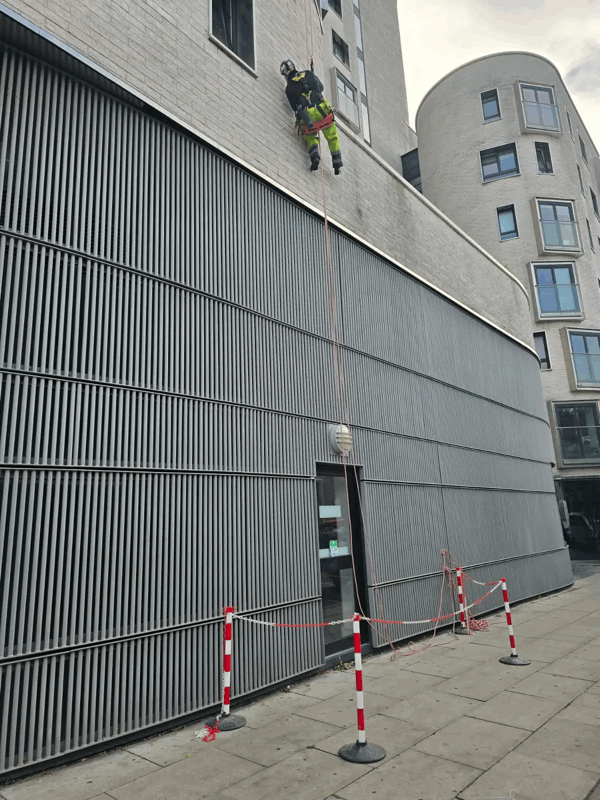
Choosing the right access method is vital. While scaffolding is traditional, it can be invasive and pose security risks for residents. Depending on the building's height and footprint, we may use mast climbers (MCWPs) or industrial rope access for specific tasks. Mast climbers often provide a more stable platform for removing heavy HPL panels while allowing more light into residents' windows than dense scaffolding.
Resident Liaison and Safety
Clear communication is the foundation of a successful project. Residents need to know when work will be happening outside their windows, how noise will be managed, and what the fire safety plan is during the "open wall" stage. When combustible HPL cladding is removed, the building is temporarily more vulnerable, requiring enhanced fire monitoring or "waking watches" until the new fire breaks are installed.
Book a hpl cladding remediation survey
Cost Considerations and Funding for HPL Remediation
The cost of remediation is a significant concern for building owners and leaseholders. In the UK, several funding routes exist to help offset these costs, though eligibility criteria are strict.
Potential Funding Sources:
- The Building Safety Fund (BSF): Available for residential buildings over 18 metres to cover the cost of replacing unsafe cladding.
- The Cladding Safety Scheme (CSS): Aimed at buildings between 11 and 18 metres.
- Developer Redress: Many major UK developers have signed a pledge to remediate buildings they constructed, covering the costs themselves.
- Insurance Claims/Legal Action: In some cases, costs can be recovered from original contractors or through NHBC/latent defects insurance.
Our team assists managing agents in preparing the technical documentation required for these funding applications, ensuring that the proposed HPL cladding remediation meets the stringent requirements of the Department for Levelling Up, Housing and Communities (DLUHC).
The Remediation Process: Step-by-Step
At CladdingTesting.com, we follow a structured methodology to ensure every project is delivered to the highest safety standards.
Phase 1: Investigation and Feasibility
We begin with a site-wide survey and intrusive testing. We identify the HPL type, the insulation material, and the presence (or absence) of cavity barriers. This phase results in a detailed report outlining the risks and the recommended remediation strategy.
Phase 2: Design and Specification
Working with architects and fire engineers, we develop a design that replaces the HPL with a compliant alternative. This includes structural calculations to ensure the existing building can support the new materials and thermal modelling to ensure the building’s U-value is maintained or improved.
Phase 3: Cladding Removal
The HPL cladding removal phase is executed with precision. Panels are carefully stripped and disposed of according to environmental regulations. During this stage, we perform a "hidden defect" survey to check the revealed substrate for any issues not caught during the initial testing.
Phase 4: Installation and Compliance
We install the new non-combustible system. This starts with the fire-rated insulation and cavity barriers, followed by the supporting rails, and finally the new façade panels. Every stage is photographed and logged for the Building Safety Case.
Phase 5: Handover and Certification
Once the work is complete, we provide a full O&M (Operation and Maintenance) manual, warranties, and the necessary documentation to support a new EWS1 rating of A1 or B1, signifying the building is fire-safe.
Choosing Replacement Materials
When HPL cladding replacement is necessary, selecting the right material is a balance of safety, aesthetics, and budget. Popular choices for UK remediation projects include:
- Solid Aluminium: Highly durable, A1 rated, and available in a vast range of colours to match original HPL aesthetics.
- Fibre Cement: A robust, non-combustible option that can mimic the texture of wood or stone, often used to maintain the building's original appearance.
- A1 Fire-Rated Ceramic or Terracotta: Excellent for longevity and thermal mass, though heavier than the HPL it replaces.
- Rockwool-based Panels: Compressed stone wool boards that offer high fire resistance and good acoustic properties.
We provide samples and mock-ups to help building owners visualise the final result, ensuring the new façade respects the original design intent while meeting modern safety standards.
Common Misconceptions About HPL Remediation
There is a lot of conflicting information regarding combustible HPL cladding. It is important to address these myths to make informed decisions.
"Only ACM cladding is dangerous"
While ACM (Aluminium Composite Material) was the focus immediately after Grenfell, research and testing (such as the BS 8414 tests) have shown that certain types of HPL can be just as hazardous, if not more so, depending on the core material and the cavity design.
"We can just paint the HPL with fire-retardant paint"
Fire-retardant coatings are generally not an acceptable solution for high-rise HPL cladding remediation. These coatings do not change the fundamental combustibility of the panel's core, nor do they address the issues of combustible insulation or missing cavity barriers behind the panels.
"The building is safe because it passed building regs when it was built"
Regulations have changed, and our understanding of how fire spreads across external wall systems has advanced. What was considered compliant 15 years ago may now be deemed a significant life-safety risk. Compliance is measured against current standards during a safety review.
Why Specialist Expertise Matters
Façade engineering is a highly specialised field. Remediation requires a deep understanding of thermodynamics, structural engineering, and moisture management. A "general builder" approach to HPL cladding remediation can lead to disastrous results, such as interstitial condensation, mould growth, or systems that still fail fire inspections because of poor cavity barrier installation.
By engaging CladdingTesting.com, you are working with a team that understands the specific nuances of the UK façade market. We don't just replace panels; we restore the integrity of the entire building envelope.
Frequently Asked Questions
What is the difference between HPL and ACM?
ACM consists of two thin aluminium skins bonded to a core (often polyethylene), while HPL is made of resin-impregnated cellulose fibres. Both can be combustible depending on their specific composition, but they require different handling and replacement strategies during HPL cladding removal.
How long does HPL remediation usually take?
The timeline varies based on building size and height. A medium-sized residential block (6-10 storeys) typically takes 6 to 12 months from the start of site works to completion. However, the pre-construction phase (testing, design, and funding) can take several months before work begins.
Will HPL remediation affect my property value?
In the short term, the presence of HPL can negatively impact value and salability. However, completing a professional HPL cladding remediation project typically restores the property’s value and makes it mortgageable again by securing a clean EWS1 certificate.
Can residents stay in the building during remediation?
Yes, in the vast majority of cases, residents remain in their homes. We use external access methods like scaffolding or mast climbers. We implement strict noise controls and dust suppression measures to ensure the building remains habitable throughout the project.
Is all HPL cladding combustible?
Not all HPL is equally dangerous, but most HPL products contain organic material that can contribute to fire spread. The level of risk is determined by the specific Euroclass rating (typically Class B, C, or D) and the presence of fire-safe components in the rest of the wall system.
Who is responsible for paying for the remediation?
Under the Building Safety Act 2022, leaseholders in buildings over 11 metres are protected from most remediation costs. Responsibility usually falls to the developer, the freeholder, or government-backed funds like the Building Safety Fund.
What happens if we ignore the HPL on our building?
Ignoring the issue can lead to enforcement action from the Fire and Rescue Service or the Building Safety Regulator. It also results in high insurance premiums, difficulty selling or remortgaging units, and, most importantly, an unmanaged fire safety risk for the occupants.
The Future of Your Building’s Façade
Navigating the complexities of HPL cladding remediation can be daunting for building owners and managing agents. The regulatory environment is demanding, and the technical requirements are precise. However, with a systematic approach—moving from detailed cladding testing to engineered remediation—it is possible to resolve these issues permanently.
At CladdingTesting.com, our goal is to provide clarity. We help you understand exactly what is on your building, why it may or may not be a risk, and what the most practical, cost-effective route to compliance looks like. Whether you require a minor intervention or a major recladding programme, our focus remains on safety, quality, and professional delivery.
If you are responsible for a building with HPL cladding and need an authoritative assessment of your next steps, contact CladdingTesting.com today. Our team is ready to help you navigate the path from investigation to a fully remediated, safe, and compliant building.
Book a hpl cladding remediation survey
What it costs
Pricing depends on building height, access and scope
Reviews
What clients say
Verified 5-star Google reviews from building owners, managing agents and contractors.