
How To Get Cladding Tested
Short answer
Understanding how to get cladding tested is a critical requirement for building owners and property managers across the United Kingdom. Whether you are addressing fire safety concerns, investigating water ingress, or assessing structural deterioration, a…
Last updated
On this page
How To Get Cladding Tested
Understanding how to get cladding tested is a critical requirement for building owners and property managers across the United Kingdom. Whether you are addressing fire safety concerns, investigating water ingress, or assessing structural deterioration, a systematic approach ensures that your building remains compliant, safe, and functional. Testing is not a singular event but a multi-staged process involving visual inspection, material sampling, and laboratory analysis.
For those managing high-rise or multi-storey assets, the complexity of cladding testing increases due to access requirements and the variety of materials used in modern external wall systems (EWS). A professional assessment identifies exactly which components are present, how they were installed, and whether they meet current British Standards and Building Regulations. This clarity is essential for determining if a building requires minor repairs, targeted remediation, or a full-scale recladding program.
Key Takeaways
- Regulatory Compliance: Testing is essential for satisfying the requirements of the Building Safety Act 2022 and obtaining EWS1 certificates.
- Material Identification: Professional testing determines the specific type of core material in ACP/ACM panels and the quality of insulation.
- Holistic Assessment: Beyond just the panels, testing evaluates cavity barriers, fire stops, and fixing integrity.
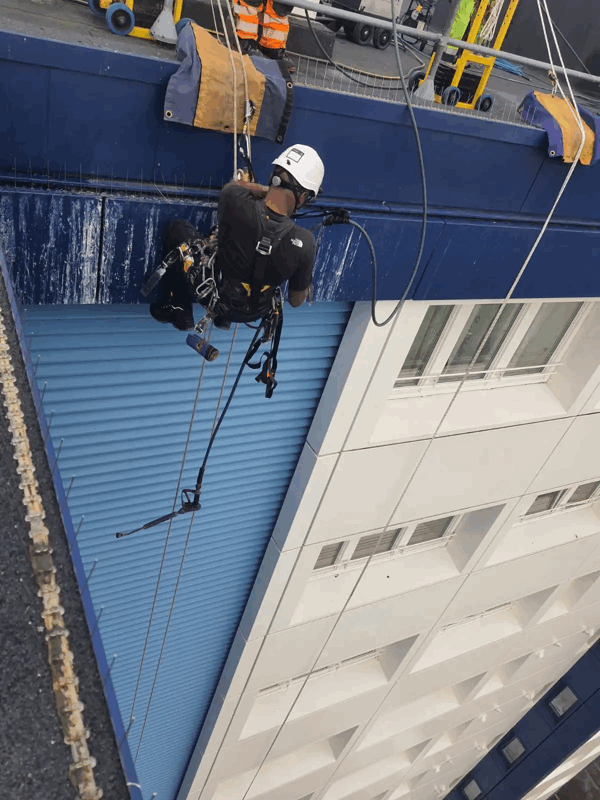
- Access Solutions: Specialists use rope access, MEWPs (cherry pickers), or mast climbers to reach every elevation of a high-rise building.
- Solution-Focused: Results from cladding testing dictate whether you need localized repairs or complete replacement.
- Risk Management: Early detection of failed seals or corroded fixings prevents costly water damage and structural failure.
What is Cladding Testing?
Cladding testing is the technical process of evaluating the performance, composition, and safety of a building’s external envelope. It involves both intrusive investigations (physically opening the façade) and non-intrusive inspections (visual and thermal) to gather data on the system’s condition. The primary goal is to verify that the materials and their installation match the original design intent and comply with safety standards.
When determining how yo get cladding tested, it is important to realize that the process covers more than just fire safety. While combustibility is a major focus, testing also identifies structural defects, such as failed mechanical fixings, and performance issues like moisture entrapment. For building owners, this data provides a clear roadmap for long-term asset management and liability reduction.
Common Testing Objectives
- Identifying the presence of Aluminium Composite Material (ACM) or High-Pressure Laminate (HPL).
- Verifying the presence and correct installation of cavity barriers and fire stopping.
- Testing for water ingress that could lead to mold or structural rot within the sub-frame.
- Checking the pull-out strength of fixings to ensure panels are secure in high winds.
- Determining the thermal efficiency of the insulation layer.
How to Get Cladding Tested: The Process
The journey toward a certified building envelope begins with a professional inquiry. Because every building is unique, the testing process must be tailored to the specific height, location, and construction type of the property. Below is the standard methodology used by façade specialists to ensure a comprehensive evaluation.
Step 1: Desktop Study and Documentation Review
Before arriving on-site, a specialist will review all available "as-built" drawings, operation and maintenance (O&M) manuals, and previous fire risk assessments. This helps the team understand the intended design and identifies potential "weak spots" where installation errors commonly occur. If documentation is missing—which is frequent in older multi-storey buildings—the physical inspection becomes even more vital.
Step 2: On-Site Visual Inspection
A high-level visual survey is conducted to identify obvious signs of distress. This includes checking for delamination, panel warping, failed sealant joints, and staining. Specialists utilize drones or high-magnification photography to capture details on upper floors that are not visible from the ground. This phase helps narrow down the specific areas that require intrusive sampling.
Step 3: Intrusive Investigation and Sampling
This is the core of how to get cladding tested. Technicians remove small sections of the cladding panels to inspect the "makeup" of the wall behind them. This allows the team to see the insulation type, the air gap, the secondary steelwork, and the fire barriers. Material samples are then taken for laboratory analysis, particularly if the core of a panel is of an unknown combustible nature.
Step 4: Laboratory Analysis
Samples are sent to UKAS-accredited laboratories. Here, they undergo tests such as the bomb calorimeter test (to measure energy release) or furnace testing to determine fire resistance ratings. The results categorized materials into Euroclasses (e.g., A1 non-combustible to E or F combustible). This data is the foundation of any subsequent remediation strategy.
Step 5: Technical Reporting and Recommendations
Finally, a detailed report is produced. At CladdingTesting.com, we focus on providing actionable insights. We don't just tell you a panel is defective; we explain the implications for the whole building and provide options for repair, remediation, or replacement. This helps managing agents and owners make informed financial and safety decisions.
Types of Specialized Cladding Tests
Depending on the initial findings, several specialized tests may be required to ensure the long-term integrity of the façade. Understanding these options is key for property professionals who need to justify testing budgets to stakeholders or residents.
Fire Performance Testing
Focuses on the combustibility of the cladding core and insulation. It also evaluates whether the cavity barrier system will effectively prevent the "chimney effect," where fire spreads rapidly through the void behind the panels. This is a mandatory consideration for high-rise residential buildings over 11 or 18 meters.
Moisture and Weathertightness Testing
Water ingress is a leading cause of cladding failure. Hose testing or spray bar testing involves applying water to the façade at specific pressures to see if leaks occur. This is particularly important for commercial buildings where internal water damage can disrupt operations and damage expensive equipment.
Structural and Fixing Integrity
Over time, wind loads and thermal expansion can loosen the fixings that hold panels in place. Pull-out tests measure the force required to remove a fixing, ensuring that the cladding will not detach during a storm. We also check for galvanic corrosion where dissimilar metals (like aluminum and steel) meet without proper isolation.
Access Methods for Cladding Testing
One of the biggest hurdles in how to get cladding tested on multi-storey buildings is access. The method chosen affects the cost, speed, and level of disruption to the residents. A specialist team will assess the building's footprint and height to choose the most efficient method.
- Rope Access (Abseiling): Often the most cost-effective and least disruptive method. Qualified technicians can move quickly across the façade to take samples without the need for heavy machinery or scaffolding.
- Mobile Elevated Work Platforms (MEWPs): Suitable for lower-rise buildings or lower levels of high-rises. They provide a stable platform for carrying heavier tools and larger samples.
- Mast Climbers: Ideal for large-scale, deep-dive investigations where significant portions of the façade need to be opened up across a wide area.
- Drones: Used for initial thermal imaging and high-resolution visual surveys to identify areas of heat loss or surface damage before sending people up.
Why You Should Get Your Cladding Tested
Many building owners hesitate to initiate testing due to the fear of what they might find. However, ignoring potential issues is a significant risk. Professional cladding testing provides several commercial and safety advantages that far outweigh the initial cost of the survey.
1. Life Safety and Fire Compliance
The primary reason for testing is the safety of the occupants. Modern regulations require a high degree of certainty regarding the fire performance of external walls. Testing provides the evidence needed to satisfy the Fire Safety Act and the Building Safety Act, ensuring that residents can feel secure in their homes.
2. Insurance and Mortgage Requirements
Without documented proof of cladding safety, such as a satisfactory EWS1 form, many lenders will refuse mortgages for individual flats. This makes the properties virtually unsellable. Similarly, insurance premiums can skyrocket or cover can be withdrawn entirely if the cladding system is an "unknown quantity."
3. Protecting the Sub-Structure
If cladding is failing to keep water out, the hidden light-gauge steel frame or timber kit behind it could be rotting or corroding. Testing identifies these leaks early. It is much more cost-effective to carry out targeted cladding repairs and reseal joints than it is to replace a structurally compromised frame five years down the line.
4. Informed Remediation Planning
Not every building needs a full reclad. Cladding testing identifies if only specific elevations or specific materials are at fault. You might find that the panels are safe, but the cavity barriers were missed during construction. In this case, remediation—fixing the barriers—is significantly cheaper than a full replacement.
How To Get Cladding Tested
Understanding the Results: Repair vs. Replace
Once you have gone through the steps of how to get cladding tested, you will be faced with a technical report. A specialist firm like CladdingTesting.com will help you interpret these findings. The outcome usually falls into one of three categories.
Localized Cladding Repair
If the testing shows that the system is generally sound but has specific areas of damage—such as a few dented panels, failed gaskets, or minor sealant degradation—a repair strategy is recommended. This restores the building's aesthetic and weathertightness without major capital expenditure.
Cladding Remediation
Remediation is suggested when the cladding panels themselves are acceptable, but the installation is non-compliant. Common examples include missing fire breaks or incorrectly installed flashing. In these scenarios, the panels are carefully removed, the internal issues are corrected, and the original panels (or new compliant ones) are reinstalled.
Complete Cladding Replacement (Recladding)
If the testing reveals high-risk materials like ACM Category 3 or combustible insulation in a high-rise context, full replacement is often the only viable path. This involves a comprehensive project to strip the building back to its structure and install a completely new, fully compliant modern façade system.
Common Challenges in High-Rise Testing
Testing a tall, occupied building presents unique logistical hurdles. A professional façade company must account for these factors to ensure the project stays on track and within budget while maintaining the safety of the public and the residents.
Resident Disruption: Intrusive testing involves noise and workers outside windows. Clear communication and scheduled "noisy hours" are essential. We ensure that all openings made for testing are immediately made weather-tight so that residents do not suffer from drafts or leaks during the process.
Logistics and Storage: On tight urban sites, finding space for access equipment and stored samples is difficult. Efficient sequencing is required to move equipment around the building elevations without blocking emergency exits or public footpaths.
Façade Interfaces: Cladding does not exist in a vacuum. It interacts with windows, balconies, rooflines, and vents. Testing must examine these interfaces to ensure that fire or water cannot bypass the main cladding system at these vulnerable junctions.
Regulations and Standards in the UK
Navigating the legal landscape is a key part of how to get cladding tested. Following the Grenfell Tower tragedy, the UK regulatory environment has become much stricter. Compliance is no longer optional; it is a statutory requirement for many building owners.
- The Building Safety Act 2022: This legislation introduced new roles, such as the "Accountable Person," who has a legal duty to assess and manage building safety risks.
- PAS 9980: This provides a methodology for the fire risk appraisal of external wall finishes and cladding of multi-storey, multi-occupied residential buildings.
- Approved Document B: The building regulation focused on fire safety, which sets out the requirements for materials used in the external walls of high-rise buildings.
- EWS1 (External Wall System) Process: A valuation requirement developed by RICS to help lenders assess the risk of a building's cladding system.
The Cost of Cladding Testing
While building owners are often concerned about the cost, it is important to view testing as a risk-mitigation investment. The price of cladding testing varies based on the size of the building, the number of samples required, and the access methods used. However, the cost of not testing—potential fire risk, insurance hikes, and building devaluation—is far higher.
A typical investigation includes the cost of the access equipment, the surveyor's time, the laboratory fees for material analysis, and the production of the final professional report. For large portfolios, specialists can often develop a phased testing program to spread the costs across financial years while still addressing the highest-risk buildings first.
It is also worth noting that under certain government schemes, such as the Building Safety Fund, some costs related to the investigation and remediation of unsafe cladding may be covered. Professional testing reports are a prerequisite for applying for these funds.
Frequently Asked Questions
Who is responsible for getting cladding tested?
The responsibility typically falls on the Building Owner, Freeholder, or Responsible Person (as defined by the Regulatory Reform (Fire Safety) Order 2005). Managing agents often coordinate the testing on behalf of these parties to ensure the building remains compliant with the law.
How long does the testing process take?
A standard investigation for a medium-sized multi-storey building usually takes 1 to 2 weeks for the on-site work and another 2 to 4 weeks for laboratory results and report writing. However, this can vary depending on the complexity of the façade and the availability of access equipment.
Do I need to test my cladding if the building is under 11 meters?
While the strictest fire safety regulations regarding combustible materials often target buildings over 11 or 18 meters, any building owner has a duty of care. Testing is still recommended if there are signs of water ingress, structural movement, or if you are planning to sell the property and a buyer's surveyor raises concerns.
Can cladding be tested without damaging the building?
Initial surveys using drones and thermal imaging are non-destructive. However, to get a definitive answer on the internal makeup and fire safety, intrusive testing is necessary. This involves removing small samples. A professional team will always ensure these areas are temporarily sealed and permanently repaired after the samples are taken.
What happens if the test results show the cladding is unsafe?
If testing identifies a risk, the next step is a Fire Risk Appraisal of External Walls (FRAEW). This professional assessment determines if the risk is tolerable or requires action. We then help you develop a strategy for remediation or replacement, helping you navigate the design, planning, and construction phases to make the building safe.
Does an EWS1 form count as a cladding test?
An EWS1 form is the result of an assessment process that often includes testing. To sign an EWS1 form, a qualified professional usually needs to conduct the very investigations described in this guide to confirm the materials present in the external wall system.
What is the difference between cladding repair and recladding?
Cladding repair involves fixing specific, localized issues like a broken panel or a leak. Recladding is a major project where the entire existing system is stripped away and replaced with new materials. Testing is what tells us which of these two approaches is necessary and safe.
How often should cladding be inspected?
While a full intrusive test may only be needed once to establish the "baseline" safety of the materials, visual inspections should be part of your annual planned preventative maintenance (PPM). This helps catch minor issues like failed seals before they turn into major structural problems.
Conclusion: Taking the Next Step
Dealing with façade issues can be a daunting prospect for any property professional. The technical jargon, shifting regulations, and potential costs create a complex environment. However, the path forward is always cleared by accurate data. By understanding how to get cladding tested, you transition from a position of uncertainty to a position of control.
Whether you are managing a single residential block or a national commercial portfolio, the goal remains the same: a safe, compliant, and durable building envelope. At CladdingTesting.com, we provide the technical expertise to identify defects, the laboratory support to verify materials, and the construction experience to deliver repairs or full-scale replacement. If you are concerned about the condition or compliance of your building's exterior, a professional assessment is the only way to determine exactly what needs to happen next.
How To Get Cladding Tested