
Can Rainscreen Cladding Be Easily Repaired Or Replaced If Damaged
Short answer
Managing a high-rise building or a large commercial development involves balancing aesthetic appeal with structural integrity and fire safety. When a building’s exterior shows signs of wear, moisture ingress, or impact damage, the immediate concern for…
Last updated
On this page
Can Rainscreen Cladding Be Easily Repaired Or Replaced If Damaged
Managing a high-rise building or a large commercial development involves balancing aesthetic appeal with structural integrity and fire safety. When a building’s exterior shows signs of wear, moisture ingress, or impact damage, the immediate concern for property managers is whether can rainscreen cladding be easily repaired or replaced if damaged. The answer depends heavily on the specific system installed, the extent of the underlying issues, and the access requirements of the site.
Rainscreen cladding is designed as a multi-layered system, typically comprising an outer decorative panel, a ventilated cavity, and an inner layer of insulation and fire barriers. Because these systems are modular, they are technically "replaceable." However, the ease of this process is dictated by how the panels were originally fixed—whether through visible rivets, secret fixings, or interlocking cassettes—and whether the damage is isolated to the surface or indicative of a systemic failure within the external wall build-up.
Key Takeaways
- Accessibility: Modern rainscreen systems are modular, allowing for individual panel replacement without stripping the entire façade.
- Fixing Methods: Discrete "secret-fix" systems are often more complex to repair than visible rivet-fix systems due to the way panels interlock.
- Root Cause Analysis: Surface damage is easy to fix, but water ingress or thermal bridging requires a deeper cladding testing approach to identify hidden defects.
- Compliance: Any repair or replacement must strictly adhere to current UK Building Regulations, specifically regarding fire performance and cavity barriers.
- Logistics: In high-rise environments, the cost of access (scaffolding or mast climbers) often outweighs the cost of the replacement panels themselves.
Defining Rainscreen Repairability
In the context of modern UK construction, a rainscreen system is considered "easily" repairable if a single damaged component can be removed and replaced without compromising the structural integrity or weather-tightness of the surrounding bays. If the damage is purely aesthetic, such as a dented Aluminium Composite Material (ACM) panel or a chipped terracotta tile, the process is straightforward.
However, if the damage involves the secondary support structure—the helping hand brackets and rails—or the fire-stopping cavity barriers behind the panels, the scope of work shifts from a simple repair to a complex remediation project. In these instances, the "ease" of repair is diminished by the need to ensure the entire system remains compliant with the Building Safety Act and relevant British Standards.
When can rainscreen cladding be easily repaired or replaced?
- Impact Damage: If a delivery vehicle or extreme weather has damaged a lower-level panel, it can usually be swapped out quickly.
- Localized Corrosion: If specific fixings have failed due to bimetallic corrosion, these can be replaced with compliant stainless steel alternatives.
- Faded Aesthetics: Individual panels that have suffered from UV degradation or coating failure can be replaced to restore the building’s appearance.
- System Upgrades: Modern systems designed with "open-joint" configurations allow for relatively simple panel removal for maintenance inspections.
The Impact of Fixing Systems on Ease of Repair
The method used to secure your cladding panels to the building’s subframe is the primary factor in determining the difficulty of a repair. As specialists in cladding testing and remediation, we categorize these into three main types, each with its own challenges.
Visible Rivet or Screw Fix Systems
These are the most common systems found on high-rise residential blocks. The panels are fixed directly to the vertical rails using color-matched rivets. Because each panel is independent, a technician can drill out the rivets of a single damaged panel and install a new one in less than an hour, provided the color match is accurate.
The main challenge here is not the mechanics of the fix, but the "batch match" of the panel. Over time, original panels fade. Installing a brand-new panel in the middle of a ten-year-old elevation can create a "postage stamp" effect, which may be aesthetically unacceptable for high-end commercial properties.
Secret-Fix Hook-on Cassette Systems
These systems are favored for their clean, fastener-free finish. The panels are folded into "cassettes" and hooked onto a rail system. While they look superior, they are often harder to repair. In many designs, panels are installed in a specific sequence (e.g., bottom-up or left-right).
To replace a single panel in the middle of a run, you may need to disengage several surrounding panels to gain the necessary clearance. This increases labor time and the risk of damaging adjacent components during the removal process. Specialist lifting tools are often required to safely handle these cassettes at height.
Adhesive-Fixed Systems
Some ceramic or stone thin-film cladding systems use high-performance structural adhesives. Repairing these is significantly more difficult than mechanical systems. Removing a damaged panel often involves carefully cutting through the adhesive bond without damaging the subframe or the vapor membrane behind it. Replacement requires perfect weather conditions to ensure the new adhesive cures correctly.
Identifying Systemic vs. Localized Damage
Before commissioning a repair, it is vital to understand if the visible damage is an isolated incident or a symptom of a wider failure. A single loose panel might suggest a localized fixing error, but if multiple panels across different elevations are rattling or showing signs of movement, the issue is likely systemic.
Signs of Systemic Failure
If your building envelope shows any of the following, a simple replacement of the damaged panel will not suffice:
- Extensive Oil-Canning: Rippling or buckling across multiple panels suggests the system was not allowed enough room for thermal expansion.
- Uniform Sealant Failure: If joints are cracking throughout the building, the original sealant may have reached the end of its service life.
- Persistent Water Ingress: Damp patches on internal walls often indicate that the internal drainage or the weather barrier behind the cladding has failed.
- Missing Cavity Barriers: If inspections reveal that fire breaks were never installed or were installed incorrectly, the entire system requires remediation to meet safety standards.
In these scenarios, CladdingTesting.com performs a detailed forensic investigation to determine the extent of the defect. We often find that what appears to be a "quick fix" actually requires a structured remediation plan to ensure the building remains insurable and safe for residents.
The Challenges of Repairing High-Rise Façades
Repairing cladding on a single-story retail unit is fundamentally different from repairing the 15th floor of a residential tower block in a city center. The technical difficulty of the repair is often secondary to the logistical complexity of the site.
Access Requirements
For high-rise buildings, the cost of access is the most significant variable. Options include:
1. Cradle Systems: Ideal for localized repairs if the building has a permanent roof-mounted BMU (Building Maintenance Unit).
2. Mast Climbers: Efficient for replacing large sections of cladding on a single elevation.
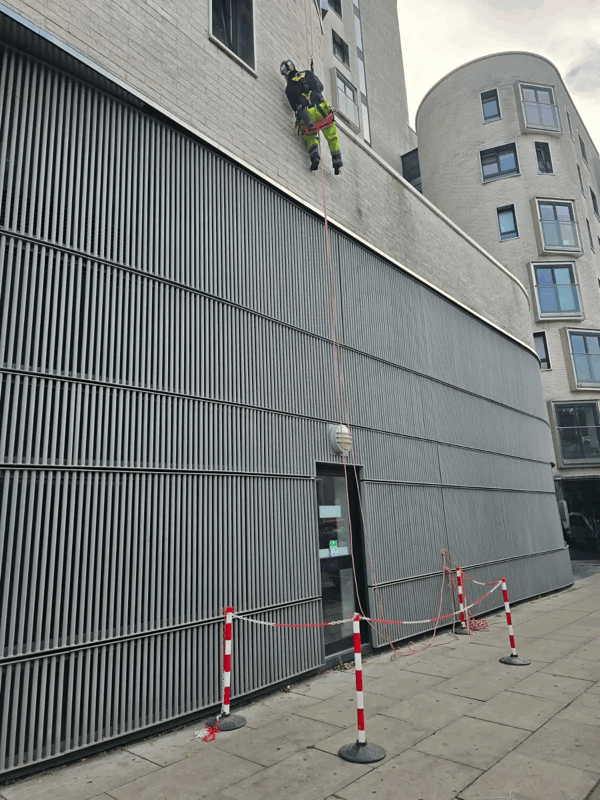
3. Rope Access (Abseiling): Often the most cost-effective method for minor repairs, panel inspections, and bolt tightening, though it has weight limitations for panel handling.
4. Scaffolding: Necessary for full recladding projects but often too expensive and disruptive for minor repairs.
Wind Loading and Safety
Rainscreen panels act as a "skin." When a panel is removed, the cavity behind it is exposed to the elements. In high-wind environments, particularly on coastal buildings or tall towers, an open cavity can create significant suction forces. Repairs must be timed during low-wind windows, and the subframe must be checked to ensure it can withstand temporary exposure without the panels providing their intended pressure-equalization.
Resident Disruption
In occupied residential buildings, repairs must be managed to minimize the impact on tenants. This includes managing noise during drilling, maintaining privacy when workers are outside windows, and ensuring that fire escape routes remain clear. A professional cladding firm will provide a clear sequence of works that accounts for these human factors.
Can Rainscreen Cladding Be Easily Repaired Or Replaced If Damaged
Can Rainscreen Cladding Be Easily Repaired or Replaced if Damaged? A Step-by-Step Methodology
If you are a managing agent or building owner dealing with damaged façade elements, following a structured process ensures that repairs are compliant and long-lasting. We recommend the following approach:
Step 1: Initial Assessment and Safety Securing
If a panel is loose or hanging, the immediate priority is public safety. An emergency team should be deployed to secure the panel or remove it. At this stage, a brief visual inspection can determine if the damage was caused by external impact or internal system failure.
Step 2: Technical Investigation
For any damage that isn't clearly caused by a one-off impact, cladding testing is required. This may involve taking a sample of the panel for lab analysis, checking the torque of the remaining fixings, or using thermographic cameras to check for moisture behind the insulation. The goal is to identify why the failure occurred to prevent a recurrence.
Step 3: Specification and Procurement
Replacement panels must match the original in terms of material composition, fire rating (typically Class A1 or A2-s1, d0), and color. Procurement can be a challenge for older buildings where the original manufacturer may no longer exist. In these cases, we work with contemporary fabricators to create bespoke matches that meet modern safety regulations.
Step 4: Execution and Documentation
The repair is carried out using the specified access method. Crucially, every repair should be documented. This includes photos of the cavity before the new panel is installed, showing that the insulation and cavity barriers are in good condition. This documentation is vital for the building's Golden Thread of information, as required by the Building Safety Act.
Cost Considerations: Repair vs. Replacement
Deciding whether to perform localized repairs or a full replacement is often a commercial decision. While a repair is cheaper in the short term, if the building requires 20-30 localized repairs every year, a full recladding project may be more economical over a five-year horizon.
Comparison of Repair vs. Replacement
| Factor | Localized Repair | Full Replacement |
| --- | --- | --- | | Upfront Cost | Lower - focused on specific areas. | High - involves major capital expenditure. | | Disruption | Minimal - usually short-term access. | Significant - long-term site presence. | | Warranty | Usually limited to the workmanship. | Full system and manufacturer warranties. | | Compliance | Addresses immediate defects only. | Brings entire building to current code. |
Common Misconceptions About Cladding Repairs
In our experience working with managing agents across the UK, several misconceptions often lead to delayed action or inappropriate repairs. Addressing these early can save significant costs.
"It’s just a dent, it doesn't matter."
While a dent in a metal panel may seem purely aesthetic, it can compromise the protective coating of the material. Over time, this leads to corrosion. More importantly, a significant impact can shift the panel, potentially putting stress on the fixings or creating a gap where water can enter the cavity in volumes the system wasn't designed to handle.
"We can just paint over the damaged area."
Standard paints are not suitable for high-performance cladding finishes like PVDF or polyester powder coatings (PPC). On-site spraying requires specialized industrial coatings and strictly controlled conditions. Applying the wrong paint can void the manufacturer’s warranty and may even alter the fire performance of the panel surface.
"Replacing one panel doesn't require Building Control."
While a "like-for-like" repair of a single panel might not always trigger a full Building Control application, any work that affects the external wall of a high-rise building should be reviewed. If the replacement involves changing the material type (e.g., replacing an HPL panel with a non-combustible fibre cement panel), it must be signed off to ensure the building’s fire strategy remains intact.
Future-Proofing Your Façade
One way to ensure that rainscreen cladding can be easily repaired or replaced if damaged in the future is to maintain a "Façade O&M Manual" (Operations and Maintenance). This should be a living document that contains:
- The exact specification of the panels (RAL colors, core material, thickness).
- The original manufacturer and installer details.
- A grid map of the building to log exactly where repairs have been made.
- Spares Strategy: For high-end or bespoke buildings, we often recommend that owners keep a small stock of matching panels in storage. This eliminates the risk of future color-matching issues.
Regular cladding testing and inspections are also vital. Catching a loose fixing or a failing seal early can prevent a panel from falling, turning a potentially dangerous and expensive incident into a routine maintenance task.
Frequently Asked Questions
Can I replace only the damaged panels, or do I need to redo the whole wall?
In most cases, individual panels can be replaced. Rainscreen cladding is designed as a modular system. However, if the damage is caused by a systemic issue like incorrect subframe installation or widespread corrosion, replacing individual panels will only be a temporary fix, and the whole wall may eventually need remediation.
How long does it take to replace a damaged cladding panel?
The physical replacement of a single rivet-fix panel can take less than an hour. However, the total lead time is usually longer due to the need for safe access (scaffolding or abseiling) and the procurement of color-matched materials, which can take several weeks if the panels are custom-made.
Is it possible to repair a dented metal cladding panel without replacing it?
Minor dents in some metal panels can be "pulled" using specialized tools, similar to automotive repair, and then touched up with specialist coatings. However, for high-rise buildings, this is often more expensive and less effective than simply replacing the panel, especially when labor and access costs are factored in.
Will my insurance cover the cost of cladding replacement?
Insurance usually covers "sudden and accidental" damage, such as fire, vehicle impact, or storm damage. It typically does not cover wear and tear, gradual deterioration, or remediation required due to non-compliant materials (like the removal of combustible ACM). You should consult your policy and a façade specialist to determine the cause of damage first.
What happens if the original cladding manufacturer is no longer in business?
This is a common issue. We work with specialized fabricators who can analyze a sample of your existing cladding and manufacture a bespoke "match" that meets current fire and safety regulations. We ensure the new panels are compatible with your existing rail system.
Do repairs to cladding require a fire safety certificate?
Any significant work on the external wall system of a high-rise building should be documented to show it complies with Regulation 7 of the Building Regulations. While a single-panel repair may not require a full EWS1 form update, the work should be carried out by specialists who can provide a certificate of conformity for the materials and installation.
At CladdingTesting.com, we specialize in navigating these complexities. Whether your building requires a minor repair or a complete façade overhaul, our team provides the technical expertise to ensure the work is done safely, legally, and to the highest professional standards. Understanding whether can rainscreen cladding be easily repaired or replaced if damaged is just the first step; executing that work correctly is what ensures the long-term viability of your property.
Can Rainscreen Cladding Be Easily Repaired Or Replaced If Damaged