
cladding sealant failure
Cladding Sealant Failure
The external envelope of a high-rise building is a complex assembly of panels, insulation, and structural supports, but its long-term integrity often rests on the performance of a few millimetres of flexible material. Cladding sealant failure represents one of the most common yet significant maintenance challenges for property managers and building owners across the UK. When these joints compromise, the building’s primary defence against water ingress, air leakage, and thermal loss is lost, potentially leading to expensive structural remediation or internal damage.
On this page
12 min read
Last updated
Cladding Sealant Failure
The external envelope of a high-rise building is a complex assembly of panels, insulation, and structural supports, but its long-term integrity often rests on the performance of a few millimetres of flexible material. Cladding sealant failure represents one of the most common yet significant maintenance challenges for property managers and building owners across the UK. When these joints compromise, the building’s primary defence against water ingress, air leakage, and thermal loss is lost, potentially leading to expensive structural remediation or internal damage.
A failed cladding sealant is rarely a standalone issue; it is often a symptom of underlying movement, poor initial installation, or natural material degradation. In the context of the UK’s stringent Building Safety Act and evolving fire safety regulations, understanding the condition of façade joints is no longer just about preventing leaks—it is about ensuring the holistic performance of the external wall system. Effectively managing these failures requires a transition from reactive "patching" to a structured, technical approach involving detailed inspection and high-specification replacement.
Key Takeaways
- Cladding sealant failure is a primary cause of water ingress and accelerated deterioration in multi-storey building envelopes.
- Failures typically manifest as adhesion loss (peeling from the substrate) or cohesion loss (tearing within the sealant itself).
- A cladding joint sealant repair should only be undertaken after a thorough investigation into the cause of the failure, such as excessive building movement or UV degradation.
- Modern cladding sealant replacement projects must account for material compatibility, particularly with powder-coated aluminium or composite panels.
- Neglecting joint maintenance can lead to hidden moisture trapment, which may degrade insulation and cavity barriers behind the cladding panels.
- Access strategy is critical; high-rise repairs often require specialized cradles or industrial rope access to ensure technical precision at height.
What is Cladding Sealant Failure?
Cladding sealant failure occurs when the flexible material used to bridge the gaps between exterior panels loses its ability to maintain a weather-tight seal. This failure typically happens through the breakdown of the chemical bond between the sealant and the cladding panel, or through the physical rupture of the sealant body due to environmental stress or movement beyond its design limits.
In a high-rise environment, these joints must perform three critical functions:
- Waterproofing: Preventing rainwater from entering the cavity where it can damage insulation and fixings.
- Airtightness: Reducing heat loss and preventing "whistling" noises caused by wind pressure.
- Movement Accommodation: Allowing panels to expand and contract with temperature changes without cracking the façade.
The Primary Mechanisms of Façade Sealant Failure
Understanding why a sealant has reached the end of its service life is the first step in determining whether a building requires localised repairs or a full-scale replacement programme. Not all failures look the same, and the "why" dictates the "how" of the remediation.
Adhesive vs. Cohesive Failure
Adhesive failure is characterized by the sealant pulling away cleanly from the edge of the cladding panel. This often points to poor surface preparation during the original construction—such as failing to use a primer or applying sealant to dusty, damp, or oily surfaces. It is a common issue in failed cladding sealant cases where the bond was never truly established.
Cohesive failure occurs when the sealant itself tears down the middle while remaining stuck to the sides of the joint. This usually indicates that the building is moving more than the sealant can handle. If the joint was designed too narrow for the expected thermal expansion of the panels, the sealant is stretched beyond its "elongation at break" point, leading to physical ruptures.
UV Degradation and Weathering
In the UK, façades are subjected to intense cycles of UV radiation and temperature fluctuations. Over time, lower-quality sealants can become brittle and lose their elasticity. Once the material hardens, it can no longer accommodate the natural "breathing" of the building, leading to cladding sealant failure. You may notice the material cracking, chalking, or shrinking away from the joint edges.
Risks Associated with Neglected Sealant Joints
It is a common misconception that a small gap in a sealant joint is a minor cosmetic issue. In reality, the sealant is the "front line" of the building’s defense. When it fails, the consequences move rapidly from the exterior to the interior of the structure.
Water Ingress and Structural Corrosion
Once moisture bypasses the sealant, it enters the cladding cavity. While many systems are designed to be "drained and ventilated," excessive water ingress from failed joints can overwhelm the drainage channels. Standing water within the cavity can lead to the corrosion of aluminium or steel sub-frames and wall ties, compromising the structural security of the panels themselves.
Damaged Insulation and Mould Growth
Many modern cladding systems rely on mineral wool or PIR insulation. If this insulation becomes saturated due to facade sealant failure, its thermal performance drops significantly. Furthermore, damp insulation against the inner leaf of the building can lead to internal dampness and mould growth, affecting the health and comfort of residents in occupied apartment blocks.
Fire Safety Implications
While sealant itself is a small component, its failure can allow water to degrade intumescent cavity barriers. These barriers are designed to expand and close off the cavity in the event of a fire. If they are constantly exposed to moisture or if the sealant failure allows air to feed a "chimney effect" within the cavity, the fire performance of the entire wall system could be compromised.
Investigating Cladding Sealant Performance
Before commissioning a cladding joint sealant repair, a professional assessment is essential to ensure the root cause is addressed. At CladdingTesting.com, we advocate for a systematic investigation process that moves beyond visual checks from the ground.
Physical Inspection via Rope Access or MEWP
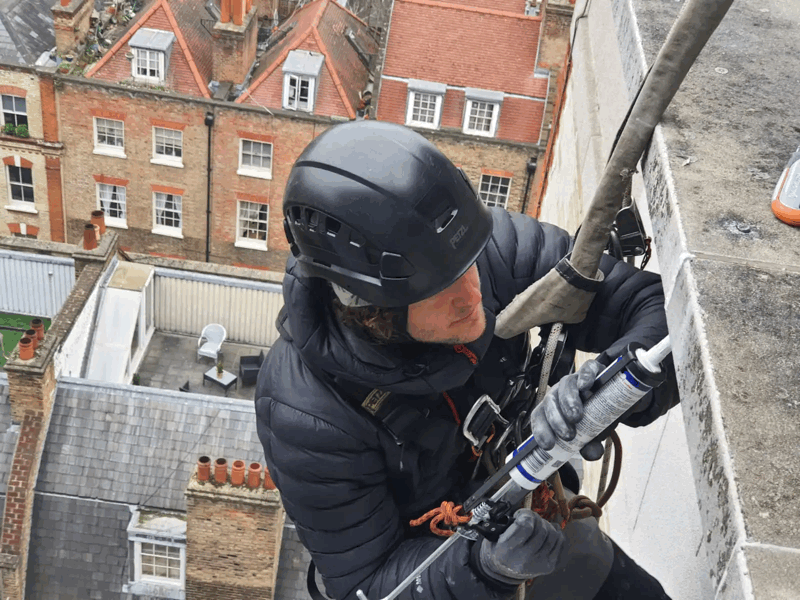
A ground-level survey using binoculars is insufficient for identifying early-stage cladding sealant failure. Technicians should access the façade directly—often via industrial rope access—to perform "probe tests." This involves physically checking the elasticity of the sealant and the strength of its adhesion to the substrate at various heights and orientations (e.g., North vs. South elevations).
Water Penetration Testing
In cases where leaks are reported but the source is unclear, we may conduct spray bar testing or hose testing. By applying controlled water pressure to specific sealant joints, we can confirm whether the failed cladding sealant is the actual point of entry or if the water is migrating from a different architectural interface, such as a window flashing or a coping stone.
Material Compatibility Analysis
If a building is undergoing cladding sealant replacement, the new material must be chemically compatible with the existing panels. Some sealants contain oils that can stain natural stone or react poorly with specific powder coatings. Our technical team identifies the existing materials to specify a replacement product that offers the longest possible service life.
The Process of Cladding Sealant Replacement
Replacing sealant on a high-rise building is a precision task. Simply "capping" old sealant with a new layer is a temporary fix that almost always fails within months. A professional remediation follows a strict multi-step protocol.
1. Removal of Failed Material
The first step in any cladding sealant replacement is the complete mechanical removal of the old, degraded material. All traces of the previous sealant must be cut away from the panel edges to ensure the new product has a clean, raw surface to bond to. This is often the most labour-intensive part of the project, especially on large-scale residential blocks.
2. Joint Preparation and Cleaning
Once the old material is removed, the joints are cleaned using specific solvent cleaners. This removes dust, grease, and atmospheric pollutants. In some cases, the edges of the cladding panels may need to be lightly abraded. For certain substrates, a primer is applied to enhance the chemical bond between the sealant and the panel.
3. Installation of Backer Rod
A common cause of cladding sealant failure is "three-sided adhesion." Sealant should only bond to the two sides of the joint, not the back. To prevent this, a polyethylene backer rod (foam strip) is inserted into the joint. This controls the depth of the sealant and ensures it maintains a "dog-bone" shape, which allows for maximum flexibility.
4. Application and Tooling
The new sealant is applied using professional-grade guns and then "tooled" to a smooth finish. Proper tooling isn't just for aesthetics; it forces the sealant into the corners of the joint, ensuring full contact with the substrate and eliminating air pockets that could lead to future failures.
Cladding Sealant Failure
Choosing the Right Materials for UK Façades
Not all sealants are created equal. The choice of material depends on the building's height, location, and the type of cladding system installed. For high-rise remediation, we typically look at three main categories:
Silicone Sealants
High-performance silicones are excellent for cladding joint sealant repair because they are highly resistant to UV and extreme temperatures. They offer excellent movement capability. However, they can be prone to "silicone staining" on certain types of masonry or porous stone cladding if the wrong grade is selected.
Polyurethane Sealants
These are often used in lower-rise commercial settings or where the sealant needs to be painted. They are very tough and have excellent adhesion to a wide range of materials. However, they generally have lower UV resistance than silicones and can become brittle faster in exposed high-rise environments.
Hybrid Polymer Sealants
Hybrids combine the best features of silicone and polyurethane. They are increasingly popular for cladding sealant replacement because they are solvent-free, can be applied to damp surfaces, and offer excellent weather resistance without the staining risks associated with some silicones.
Logistics and Access Challenges in High-Rise Remediation
Carrying out cladding sealant failure repairs on occupied high-rise buildings requires meticulous planning. Unlike new-build projects, remediation work must account for the safety and privacy of residents, as well as the logistical constraints of an active urban environment.
Access Methods: Ropes, Cradles, and Towers
- Industrial Rope Access (Abseiling): Often the most efficient method for targeted repairs. It allows technicians to move quickly across the façade with minimal setup and no heavy machinery on the ground.
- Mast Climbing Work Platforms (MCWPs): Ideal for full cladding sealant replacement projects where large volumes of material and multiple workers are required on a single elevation.
- Cradles (BMUs): Utilizing the building’s existing permanent access equipment where available and certified safe.
Minimising Resident Disruption
We understand that a remediation project is also someone’s home. Our approach to Cladding Testing and repair involves clear communication schedules. We ensure that residents are informed of when work will take place outside their windows and work to minimize the duration of the "eyes-on" period for each elevation.
When to Repair vs. When to Replace
At CladdingTesting.com, we don't believe in a one-size-fits-all solution. Every building is assessed on its own merits. The decision between localized cladding joint sealant repair and full replacement depends on several factors.
The "20% Rule"
Generally, if more than 20-25% of the sealant joints on a façade are showing signs of cladding sealant failure, it is often more cost-effective in the long term to undertake a full replacement. Patch-repairing individual sections can lead to a "checkerboard" effect of different ages and types of sealant, making future maintenance planning nearly impossible.
Age and Service Life
Most high-quality façade sealants have a service life of 15 to 25 years. If a building is approaching the 20-year mark, even "healthy-looking" joints may be nearing chemical exhaustion. In these cases, a proactive cladding sealant replacement programme is a better investment than waiting for widespread leaks to occur.
Integration with Other Works
If a building is already undergoing cladding remediation for fire safety or insulation upgrades, it is the logical time to address the sealants. Combining these works significantly reduces access costs, which can often account for up to 60% of the total budget on high-rise projects.
Maintenance Strategies for Property Managers
Proactive management of the building envelope can prevent a failed cladding sealant from turning into a major capital expenditure crisis. We recommend that managing agents include façade joint inspections in their five-year planned preventative maintenance (PPM) schedules.
Annual Visual Inspections
A simple high-resolution drone survey or a walk-around by a specialist can identify early warning signs like "trailing" sealant or visible gaps. Catching these early allows for minor cladding joint sealant repair before water reaches the building interior.
Record Keeping
Maintaining a "façade logbook" that records the types of sealants used, the dates of application, and the results of previous inspections is invaluable. This data allows for more accurate budgeting and ensures that future contractors use compatible materials.
Frequently Asked Questions
How long does cladding sealant usually last?
Most professional-grade façade sealants are designed to last between 15 and 25 years. However, this lifespan can be shortened by extreme weather exposure, poor initial installation, or significant structural movement. Regular inspections are recommended after the 10-year mark.
Can you just put new sealant over the old failed sealant?
No. This is known as "capping" and is a primary cause of premature failure. The new sealant will not bond properly to the old, degraded material, and the joint will likely fail again within months. Proper cladding sealant replacement requires full removal and cleaning of the joint.
Is sealant failure covered by building warranties?
It depends on the cause. If the failure is due to poor workmanship or the use of incorrect materials during construction, it may be covered under a latent defects insurance policy (like NHBC or Premier Guarantee) if identified within the warranty period. However, natural wear and tear is usually considered a maintenance item.
Does a failed sealant mean my building is a fire risk?
A failed cladding sealant is primarily a water ingress risk rather than a direct fire risk. However, if the failure allows moisture to degrade internal fire-stopping components like cavity barriers, it could indirectly impact the building's fire safety performance. An inspection by CladdingTesting.com can help clarify the specific risks for your building.
What is the best time of year to replace cladding sealant?
Sealant application is best performed in dry conditions and within a specific temperature range (usually between 5°C and 25°C). In the UK, this typically means the spring and autumn months are ideal. Applying sealant in extreme heat can cause it to "skin" too quickly, while very cold or wet weather can prevent proper adhesion.
How do I know if my building has adhesive or cohesive failure?
Adhesive failure is when the sealant peels away from the panel edge, leaving the panel clean. Cohesive failure is when the sealant itself splits in two. A technical survey can identify which mechanism is at play, which is crucial for determining if you need a different material or a wider joint design.
The Path Forward: Systematic Façade Care
Managing a high-rise building comes with a significant responsibility to maintain the safety and integrity of the external envelope. Cladding sealant failure may seem like a small detail, but it is the gateway to more complex and expensive building fabric issues.
By treating sealant as a critical component rather than a minor consumable, building owners can extend the life of their cladding systems and avoid the disruption of emergency repairs. Whether your building requires a targeted cladding joint sealant repair or a comprehensive cladding sealant replacement, the process must be rooted in technical investigation and expert application.
At CladdingTesting.com, we provide the clarity needed to navigate these challenges. From initial drone surveys and abseiling inspections to the project management of large-scale recladding and remediation, we ensure that every joint and panel is performing exactly as it should. If you are concerned about the condition of your façade, the first step is a professional assessment to determine the most practical and cost-effective route to a secure, weather-tight building.
Cladding Sealant Failure