
Glossary · Two-word term
Fixing Failure
In short
the inability of an attachment element to perform its intended function
Fixing failure refers to the inability of an attachment element, such as a bolt or bracket, to perform its intended structural function within a cladding system. This technical concept is central to building safety assessments and long-term facade integrity.
Last updated
On this page
Fixing Failure
Definition and Scope of Fixing Failure
In the context of the UK building envelope sector, a fixing failure refers to the inability of an attachment element to perform its intended function. This encompasses any component used to secure cladding panels, rails, brackets, or insulation to the primary substrate of a building. The "intended function" typically involves resisting gravitational loads (dead loads) and environmental pressures, most notably wind suction (negative pressure) and wind loading (positive pressure).
Fixing failure is rarely a binary state observed only when a component detaches. Instead, it is a spectrum of performance degradation. It may manifest as mechanical yielding, shear failure, pull-out from the substrate, or the degradation of the fixing material itself through galvanic corrosion or hydrogen embrittlement. In engineering terms, a failure occurs when the actual load-bearing capacity of the fixing falls below the design load requirements, regardless of whether the system remains superficially in place.
Mechanical and Material Interactions
The external wall system is a complex assembly where the fixing acts as the critical interface between different materials. A fixing failure often arises not from a defect in the bolt or screw itself, but from an incompatibility between the fixing and the substrate. In the UK, substrates vary widely, including reinforced concrete, steel SFS (Steel Framing Systems), masonry, and timber.
Specific mechanical interactions define the success of a fixing. For instance, in masonry substrates, the failure may occur within the substrate (cone failure) rather than the metal fixing. In thin-gauge steel framing, the risk often pertains to "strip-out," where the threads of the fixing shear the internal surface of the steel profile. Furthermore, thermal expansion and contraction cycles place repetitive stress on fixings; if the system design does not account for this movement, the resulting fatigue can lead to a gradual loss of structural integrity over the building's lifecycle.
Role in Testing and Site Investigations
Fixing performance is a central pillar of facade condition surveys and EWS1 (External Wall System) assessments. When professionals conduct intrusive inspections, they evaluate the frequency, type, and condition of fixings against the original design specifications or current British Standards.
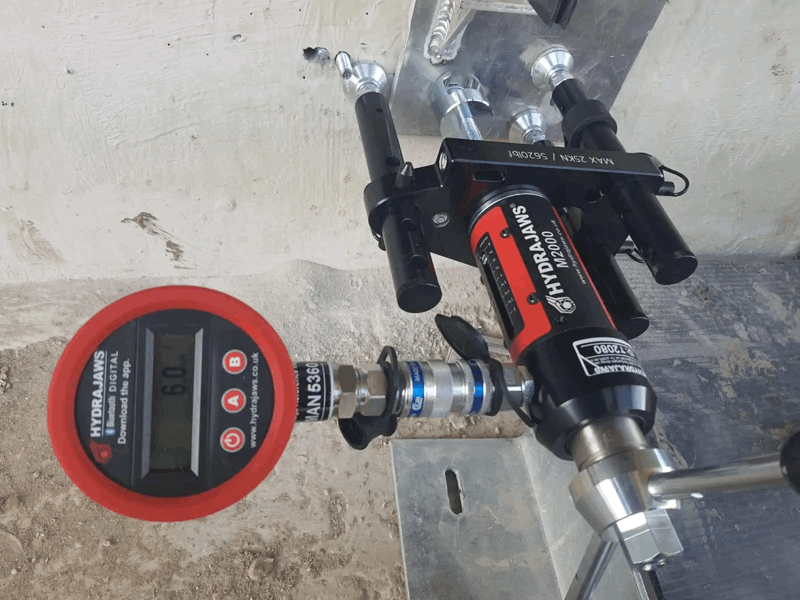
Site testing often involves "pull-out tests," conducted in accordance with Construction Fixings Association (CFA) guidance. These tests determine the allowable load of a fixing in a specific substrate by applying a measured tensile force until a predetermined load is reached or the fixing fails. This empirical data is essential when original construction records are missing or when the substrate's quality is questioned. Testing protocols typically distinguish between:
| Test Type | Objective |
|---|---|
| Proof Testing | Verifying the quality of installation on a live project. |
| Allowable Load Testing | Determining the load-bearing capacity in unknown substrates. |
| Failure Analysis | Investigating the root cause after a displacement event. |
Fixing Failure
Regulatory Context in England and Wales
The regulatory landscape regarding fixings has tightened significantly following the introduction of the Building Safety Act 2022 and updates to the Building Regulations, specifically Requirement A1 (Structural Safety) and Requirement B4 (External Fire Spread). While much public discourse focuses on the flammability of cladding cores, the structural stability of the attachment system is equally critical under the functional requirements of the regulations.
For high-rise residential buildings (HRBs), the Accountable Person must maintain a "Golden Thread" of information. This includes specifications for the fixings used in the external wall system. If fixing failures are identified during a mandatory building safety assessment, it may necessitate a broader remediation strategy. The Office for Building Safety oversees these standards, ensuring that materials used in repairs are not only non-combustible (where required) but also mechanically sufficient for the specific height and location of the building.
Implications for Building Management
For RMC (Residents' Management Company) directors and managing agents, understanding fixing failure is necessary for long-term maintenance planning. Unlike aesthetic weathering, fixing issues are often hidden behind the external rainscreen and may only be detectable through professional intrusive inspection.
When a "failure" is identified in a professional report, it does not always imply an immediate risk of falling debris. It may indicate that the original installation does not meet the safety factors required by current Eurocodes or British Standards (such as BS 5427). Management teams must distinguish between "systemic failure," where an incorrect fixing was used throughout the project, and "isolated failure," which may result from poor workmanship on specific panels. Remediation strategies vary significantly between these two scenarios, with the former often requiring a full strip-out and replacement of the support grid.
Common Misunderstandings
A frequent misunderstanding is the belief that a fixing is only "failing" if it is visibly loose or broken. In technical terms, a fixing that has undergone "creep"—permanent deformation under a constant load—has failed its serviceability limit state, even if the panel remains attached. Another misconception involves the substitution of parts; using a high-quality fixing in an incompatible substrate (such as a concrete bolt in a hollow brick) constitutes a fixing failure by design, regardless of the bolt’s individual strength.
Additionally, the role of corrosion is often underestimated in coastal or high-pollution environments. Stainless steel fixings are frequently specified (A2 or A4 grade), but the use of carbon steel fixings in an external cavity—where they are exposed to moisture—can lead to "hidden" failures. The expansion of oxidising metal can also cause "jacking," where the rust exerts pressure on the cladding panel, leading to secondary fractures.
Related Terminology and Technical Concepts
Fixing failure is closely linked to several other technical concepts within the facade industry:
- Edge Distance: The minimum distance a fixing must be placed from the edge of a substrate to prevent the material from cracking or blowing out.
- Embedment Depth: The depth to which a fixing is inserted into the structural substrate; insufficient depth is a primary cause of pull-out failure.
- Bimetallic (Galvanic) Corrosion: The chemical reaction that occurs when two dissimilar metals (e.g., an aluminium rail and a carbon steel screw) contact each other in the presence of an electrolyte, leading to the rapid degradation of one metal.
- Pull-over Failure: A specific type of failure where the cladding panel is pulled over the head of the fixing, often due to high wind loads or the use of washers that are too small.
- Safety Factor: The ratio of the ultimate strength of a fixing to the actual expected load; a reduction in this factor due to age or wear is often classified as a failure in technical assessments.
Professional assessments generally conclude that the longevity of a cladding system is only as robust as its weakest connection point. Consequently, the rigorous verification of fixing integrity remains a mandatory component of modern UK building stewardship.
Fixing Failure