
PAS 9980 assessment
PAS 9980 Assessment
A PAS 9980 assessment is a formal methodology used to evaluate the fire risk of external wall systems on multi-storey residential buildings. Introduced by the British Standards Institution (BSI) in early 2022, it provides a structured framework for competent professionals to determine whether a building’s cladding and wall construction pose an acceptable or unacceptable risk to life safety. Rather than focusing solely on whether materials are combustible, the assessment considers the entire wall assembly and how a fire might spread across the building envelope.
Independent
UK-wide coverage
Survey options
Clear reporting
On this page
Book a pas 9980 assessment survey
A PAS 9980 assessment is a formal methodology used to evaluate the fire risk of external wall systems on multi-storey residential buildings. Introduced by the British Standards Institution (BSI) in early 2022, it provides a structured framework for competent professionals to determine whether a building’s cladding and wall construction pose an acceptable or unacceptable risk to life safety. Rather than focusing solely on whether materials are combustible, the assessment considers the entire wall assembly and how a fire might spread across the building envelope.
Key Takeaways
- Risk-Based Approach: Unlike previous rigid pass/fail criteria, PAS 9980 focuses on the proportionality of risk to life safety.
- Mandatory Consideration: Following the Fire Safety Act 2021, building owners must account for external walls in their Fire Risk Assessments (FRA).
- Holistic Evaluation: The process examines cladding, insulation, cavity barriers, and the presence of features like balconies or stacked windows.
- Remediation Strategy: The outcome of a PAS 9980 survey determines if PAS 9980 remediation is necessary or if the risk can be managed through other means.
- Competence is Vital: Assessments must be carried out by qualified professionals with expertise in fire engineering and building envelopes.
- Financial & Legal Clarity: A completed assessment is often required by lenders, insurers, and the Building Safety Fund to progress building works.
For building owners and managing agents, navigating the complexities of modern fire safety legislation is a significant challenge. The introduction of PAS 9980:2022 sought to bring consistency to a landscape that was previously dominated by the EWS1 process. While EWS1 is primarily a valuation tool for lenders, the PAS 9980 assessment is a technical standard that informs the legal Fire Risk Assessment of a building. At CladdingTesting.com, we provide the technical expertise required to facilitate these investigations, ensuring that property professionals have a clear, evidence-based roadmap for their assets.
Why PAS 9980 was Introduced
In the years following the Grenfell Tower tragedy, there was an immediate move towards removing all combustible materials from high-rise buildings. While safety was the priority, this often led to "blanket" recommendations for full recladding, even where the actual risk to life was low. The PAS 9980 framework was developed to provide a more nuanced, risk-proportional methodology.
It recognises that not every building with combustible elements requires a multi-million-pound replacement programme. By looking at the building’s height, occupancy, fire suppression systems (like sprinklers), and the specific configuration of the façade, a PAS 9980 cladding assessment can identify when targeted repairs are a viable alternative to total replacement.
What is a PAS 9980 External Wall Assessment?
Technically referred to as a Fire Risk Appraisal of External Walls (FRAEW), the assessment is a deep dive into the fire performance of a building’s outer shell. It moves beyond simple material identification. A standard Cladding Testing investigation often serves as the data-gathering phase for this appraisal, identifying what is hidden behind the visible panels.
The assessment follows a specific logic to reach a risk rating:
- Data Collection: Reviewing O&M manuals, architectural drawings, and previous survey reports.
- Physical Inspection: Opening up "pilot holes" or using borescope cameras to verify the internal wall makeup.
- Fire Spread Analysis: Modelling how a fire might move vertically and horizontally across the façade.
- Risk Categorisation: Assigning a rating of Low, Medium, or High risk based on the likelihood of fire spread and the potential impact on residents.
The Difference Between EWS1 and PAS 9980
It is common for managing agents to confuse these two documents. An EWS1 (External Wall System) form is a commercial document created to satisfy mortgage lenders that a building is a safe security for a loan. PAS 9980, however, is the technical code of practice used to reach a safety conclusion. A PAS 9980 survey provides the technical evidence that allows a professional to sign an EWS1 form if required.
Key Components Evaluated During the Survey
A comprehensive PAS 9980 external wall assessment looks at the interaction between various components. It is rarely just about the cladding panel itself. The assessor will look for:
- Insulation Types: Are they combustible (e.g., PIR/PUR) or non-combustible (e.g., stone wool)?
- Cavity Barriers: Are they present, correctly oriented, and capable of expanding to seal the gap in a fire?
- Fixing Systems: Will the cladding remain attached to the building during a fire, or will it fall and create a hazard for escaping residents and firefighters?
- External Attachments: Are balconies made of timber? Are there decorative features that could fuel a fire?
The Regulatory Context: Fire Safety Act 2021
The legal driver for these assessments is the Fire Safety Act 2021, which clarified that for any building containing two or more sets of domestic premises, the Fire Safety Order applies to the building’s structure, external walls, and any common parts. This includes all elements of the wall system, such as windows, doors, and balconies.
Building owners who fail to commission a relevant assessment are technically in breach of fire safety law. If a Fire and Rescue Service inspects a building and finds no evidence of an external wall appraisal, they can issue enforcement notices. Therefore, a PAS 9980 assessment is not just a "best practice" recommendation; it is a fundamental requirement for legal compliance in the UK residential sector.
Identifying the "Responsible Person"
Under the legislation, the "Responsible Person" (usually the freeholder, Resident Management Company, or managing agent) is legally accountable for the building’s safety. Their duty is to ensure that a competent person carries out the appraisal. At CladdingTesting.com, we work alongside these Responsible Persons to provide the physical evidence needed to satisfy the requirements of a PAS 9980 report.
How a PAS 9980 Survey is Conducted
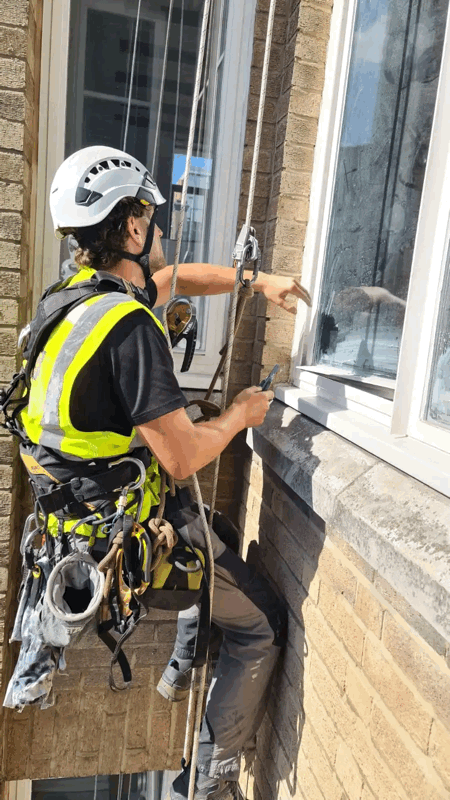
The process is methodical and requires access to various elevations of the building. Unlike a simple visual check from the ground, this is an intrusive investigation. We typically utilise Mobile Elevated Work Platforms (MEWPs), mast climbers, or industrial rope access (abseiling) to reach the upper storeys of high-rise blocks.
Phase 1: The Desktop Study
We begin by examining the "as-built" records. We look for the original cladding specifications, thermal calculations, and fire strategy documents. This helps us understand what should be there before we go out to see what is actually there. Discrepancies between drawings and reality are incredibly common in UK construction.
Phase 2: Intrusive Site Investigation
This is where the physical work happens. Our teams remove specific panels to inspect the internal wall cavity. We check for:
- The presence and spacing of cavity barriers.
- The type of insulation used behind the rainscreen.
- The condition of the vapour permeable membrane.
- Signs of water ingress or corrosion that could compromise structural integrity.
Phase 3: Laboratory Testing (If Required)
If a material cannot be identified by sight or via manufacturer branding, we take small samples for laboratory analysis. This is particularly important for Aluminium Composite Material (ACM) or High-Pressure Laminate (HPL) panels, where the core composition (PE, FR, or A2) dictates the fire risk level.
Understanding Risk Ratings
Once the data is gathered, a fire engineer uses the PAS 9980 methodology to produce a report. The results generally fall into three categories. Understanding these helps building owners plan their financial and operational response.
Low Risk
If a building is rated Low Risk, it means that while there may be some combustible materials present, they do not pose a significant threat to life safety. In these cases, no PAS 9980 remediation is required. This is a vital outcome, as it protects leaseholders from unnecessary costs and allows property transactions to proceed.
Medium Risk
A Medium Risk rating suggests that while a full reclad might not be necessary, some level of intervention is required. This might involve:
- Installing missing cavity barriers.
- Replacing timber balconies with non-combustible alternatives.
- Improving fire detection systems within the building to allow for earlier evacuation.
High Risk
A High Risk rating indicates a clear threat to life safety due to the potential for rapid fire spread. In these scenarios, the report will likely recommend significant works. This could range from replacing specific sections of the façade to a complete cladding replacement programme. At CladdingTesting.com, we specialise in managing these high-risk transitions, providing a clear path from a "High Risk" report to a safe, compliant building.
PAS 9980 Remediation: What are the Options?
When an assessment concludes that the risk is unacceptable, the focus shifts to remediation. Our philosophy is to be solution-focused. We don't just identify the problem; we outline the most practical way to fix it. Remediation doesn't always mean a total reclad.
1. Targeted Repairs and Partial Replacement
In many buildings, the risk is concentrated in specific areas—for example, around window reveals or at floor levels where cavity barriers are missing. We can often carry out localised cladding repairs, replacing only the defective elements while retaining the safe portions of the façade. This is faster, less disruptive, and more cost-effective for the client.
2. Full Recladding
For buildings with widespread flammable insulation or dangerous cladding types like ACM-PE, a full replacement is often the only route to safety. This involves the complete removal of the external wall system down to the substrate (usually concrete or steel frame) and the installation of a brand-new, A1 or A2-rated non-combustible system.
3. Mitigating Factors
Sometimes, physical changes to the wall are not the only answer. An assessment might suggest that the risk can be downgraded if the building's internal safety systems are improved. This is part of the holistic approach of PAS 9980—looking at how the building functions as a whole.
Book a pas 9980 assessment survey
The Challenges of Working on Occupied Buildings
Most PAS 9980 cladding assessment and remediation projects take place while people are living or working in the building. This introduces a layer of complexity that requires expert management. We understand that residents are often anxious about the safety of their homes and the potential for disruption.
Effective delivery on occupied buildings requires:
- Strict Noise Control: Scheduling heavy works during specific hours.
- Privacy Measures: Using window films or specific scaffolding configurations.
- Safety Protocols: Maintaining clear fire exits and ensuring the building's fire alarm remains operational throughout the works.
- Clear Communication: Providing regular updates to residents so they know what to expect and for how long.
The Role of Professionals in the PAS 9980 Process
A PAS 9980 assessment is a multidisciplinary effort. It is not something a single general contractor can sign off. The process typically involves:
- Fire Engineers: To carry out the risk modelling and sign the final FRAEW.
- Façade Specialists: Like CladdingTesting.com, to handle the access, intrusive inspections, and technical reporting of the wall's makeup.
- Surveyors: To oversee the project management and financial aspects of any remediation.
- Architects: If a new façade design is required for a full reclad.
Our role is often to act as the "eyes and ears" for the fire engineer. We provide the raw data—photographs, material samples, and installation measurements—that allows the engineer to make an informed judgement. Without accurate site data, the PAS 9980 survey is just guesswork.
Financial Implications and Funding
The cost of these assessments and the subsequent remediation can be significant. In the UK, several funding streams have been established to help leaseholders avoid these costs. The Building Safety Fund (BSF) and the Cladding Safety Scheme (CSS) are the primary vehicles for this.
To access these funds, a building owner must provide a valid PAS 9980 assessment. The government uses these reports to prioritise the most dangerous buildings and ensure that public money is spent where the risk is highest. We assist building owners by providing the technical documentation required for these funding applications, ensuring the evidence is robust and meets the specific criteria set by the Department for Levelling Up, Housing and Communities (DLUHC).
Common Pitfalls in External Wall Assessments
Having overseen numerous investigations, we have identified several common mistakes that can lead to delays or rejected funding applications:
1. Insufficient Intrusive Investigation
A report based on just one or two small holes is rarely enough for a large building. Fire spread can vary depending on the elevation and the presence of different cladding types. An assessment must be representative of the entire building.
2. Lack of Material Evidence
Simply stating that insulation "appears to be mineral wool" is not enough. Competent assessments require photographic evidence of branding or lab results to prove the material's fire classification. We ensure every finding is backed by hard evidence.
3. Ignoring "Small" Details
Often, it is the small details—like the type of mastic used around windows or the absence of "intumescent" strips in cavity barriers—that determine whether a fire will stay contained or spread. A high-quality PAS 9980 external wall assessment leaves no stone unturned.
Case Study: When Remediation is Proportional
Consider a ten-storey residential block with HPL cladding on the top two floors and non-combustible masonry on the lower eight. A rigid, old-school approach might have suggested the building was "unsafe."
However, a PAS 9980 assessment might find that because the building has a working sprinkler system and the HPL is limited to the top floors, the risk of fire spreading to other apartments is manageable. The remediation might only involve upgrading the fire breaks behind the HPL, rather than a full strip-and-replace project. This saves time, money, and resident stress.
Future-Proofing Your Building
Compliance is not a one-time event. As building regulations evolve—such as the recent changes to the Building Regulations Part B—staying ahead of safety standards is a commercial necessity. A PAS 9980 assessment provides a baseline of safety that helps protect the long-term value of the property.
It also gives insurers the confidence to provide cover. In recent years, professional indemnity and buildings insurance premiums have rocketed. A clear, professional PAS 9980 report demonstrating that a building is either safe or has a clear remediation plan in place is often the only way to stabilise these costs.
How CladdingTesting.com Supports Your Journey
We provide a clear route from initial concern to final certification. Whether you are at the start of your journey and need an initial PAS 9980 survey, or you have a report in hand and need to execute a PAS 9980 remediation plan, our team has the technical competence to deliver.
Our services include:
- Full intrusive inspections and material sampling.
- Coordination with fire engineers for FRAEW reports.
- Detailed specifications for repair or replacement works.
- Principal Contractor services for major recladding projects.
- Resident liaison and site logistics management.
The Importance of Competence
The Building Safety Act has placed a massive emphasis on competence. It is no longer acceptable to hire a general builder for these specialised tasks. By choosing a façade specialist, you are ensuring that the people looking at your building actually understand the complex physics of rainscreen systems and fire dynamics.
Frequently Asked Questions
Is a PAS 9980 assessment mandatory for all buildings?
It is legally required for multi-storey residential buildings in England that fall under the Fire Safety Order. While the focus is on buildings over 11 metres, the risk-based approach can apply to any multi-occupied building where the external walls could contribute to fire spread.
How long does a PAS 9980 external wall assessment take?
The timeline varies based on building size and the availability of original records. Generally, the site investigation takes 1–3 days, with the subsequent analysis and report generation taking 4–8 weeks. Laboratory testing of materials can add 2 weeks to the process.
What happens if my building receives a "High Risk" rating?
A "High Risk" rating means that the "Responsible Person" must take action to mitigate the risk. This usually involves commissioning a PAS 9980 remediation plan. In some cases, interim fire safety measures (like a Waking Watch or enhanced alarm system) may be required until the physical works are completed.
Can I sell my flat without a PAS 9980 report?
While you can technically list a property, most buyers' lenders will require an EWS1 form, which is informed by a PAS 9980 assessment. Without this document, the flat may be valued at zero, or the lender may refuse the mortgage until the safety of the external walls is confirmed.
Does PAS 9980 cover internal fire safety?
No. PAS 9980 is specifically focused on the external wall system. Internal fire safety, such as fire doors, compartmentation between flats, and emergency lighting, is covered by a standard Fire Risk Assessment (FRA), though the two documents should be used together to form a complete safety strategy.
How much does a PAS 9980 assessment cost?
Costs depend on the height of the building, the type of access required (e.g., cradles vs. cherry pickers), and the complexity of the wall systems. A typical assessment for a mid-sized block can range from £4,000 to £15,000. We provide bespoke quotes based on an initial desktop review of your building.
Will the Building Safety Fund pay for my assessment?
The Building Safety Fund and Cladding Safety Scheme often cover the costs of the FRAEW (the report produced via PAS 9980) as part of the wider funding application for remediation. However, the initial survey to determine if you are eligible for the fund may need to be funded by the building owner or through the service charge initially.
Who is qualified to carry out a PAS 9980 survey?
The assessment must be led by a competent fire professional, typically a chartered engineer with specific experience in façade fire performance. CladdingTesting.com provides the technical site team that supports these engineers by performing the physical inspections and material identifications.
For building owners, the path to compliance can seem daunting. The PAS 9980 assessment is designed to provide clarity. By moving away from "all or nothing" solutions and focusing on proportionate risk, it allows for a more sensible, evidence-based approach to building safety. If you are responsible for a building and are unsure of your next steps, a professional survey is the most critical tool in your arsenal to ensure the safety of your residents and the protection of your asset.
Book a pas 9980 assessment survey
What it costs
Pricing depends on building height, access and scope
Reviews
What clients say
Verified 5-star Google reviews from building owners, managing agents and contractors.